Foreign language degrees in the United States have evolved beyond traditional literature-focused programs. In 2026, advanced language skills are increasingly valued across industries such as law, healthcare, technology, international business, education, and government. While machine translation continues to grow, employers consistently seek professionals who can communicate accurately, understand cultural nuance, and operate in multilingual environments where precision matters.
U.S. universities offer some of the most comprehensive foreign language programs in the world, combining rigorous linguistic training with cultural immersion, interdisciplinary study, and strong career pathways. Below is an updated list of top U.S. universities for earning a foreign language degree, followed by current salary data, career outcomes, and guidance on choosing the right program for your goals.
Career Outcomes and Salary Outlook for Language Majors (2025–2026)
According to recent labor market analyses and university outcome reports, bilingual and multilingual professionals in the U.S. continue to earn 10–20% more on average than their monolingual peers, depending on industry and language pair. While entry-level roles may not always list language skills as a primary requirement, advanced proficiency significantly increases competitiveness for promotion and specialization.
Common career paths for foreign language majors include:
- Translation and interpretation
- Legal and medical language roles
- International business and trade
- Government, diplomacy, and intelligence
- Education and academia
Beyond traditional roles such as translation and education, bilingual professionals are increasingly in demand across healthcare, customer service, business operations, and government roles, as outlined in Indeed’s overview of popular jobs for bilingual candidates.
Professionals working with certified translations, regulated documents, or specialized terminology (legal, medical, technical) tend to see higher long-term earning potential due to the skill and accuracy required.
How These Universities Were Selected
The universities below were evaluated based on:
- Number and diversity of languages offered
- Academic reputation and research output
- Graduate outcomes and career pipelines
- Access to immersion, study abroad, and applied learning
- Institutional resources dedicated to language education
Top U.S. Universities for a Foreign Language Degree
Middlebury College

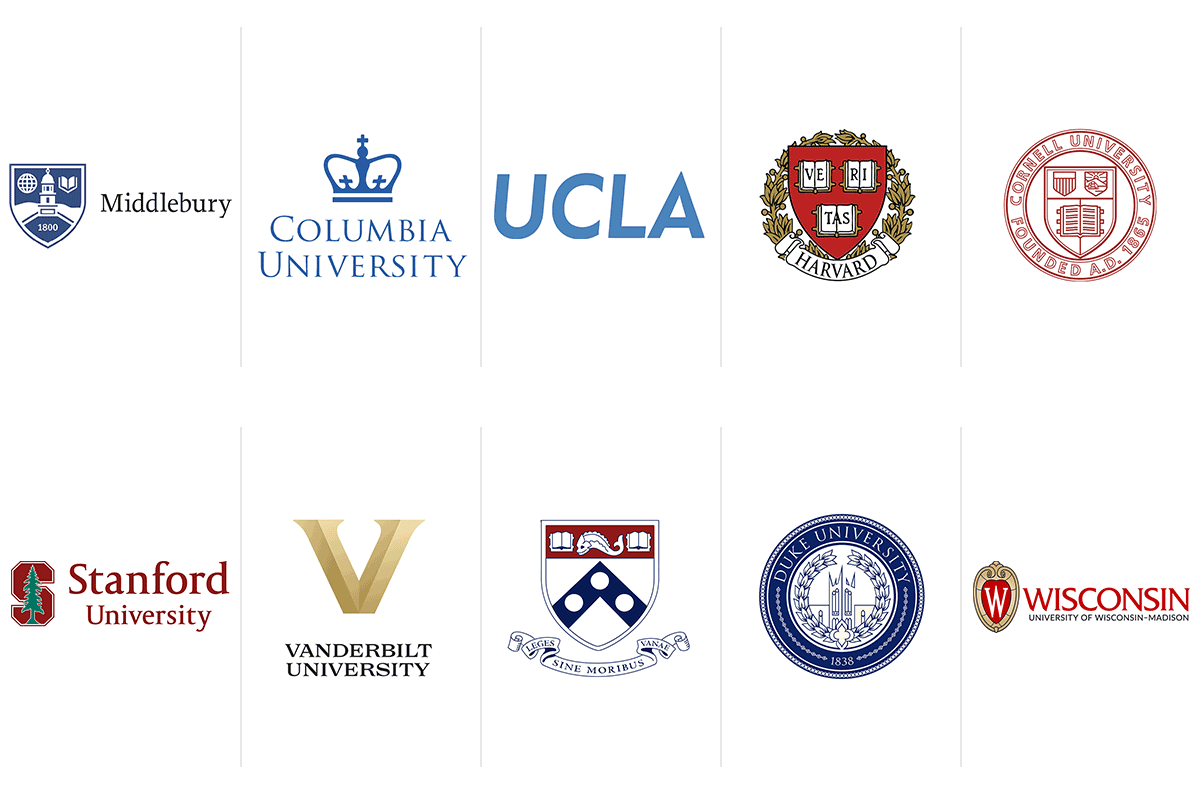
Middlebury College in Vermont is widely regarded as the premier institution for immersive language education in the U.S. Serving a small student body of approximately 2,800, Middlebury is best known for its Language Schools, which require students to commit to a strict immersion pledge. Instruction is offered in over a dozen languages, and the curriculum prioritizes near-native fluency, cultural competence, and real-world communication. Middlebury also operates extensive study abroad programs that reinforce immersive learning beyond campus. Alumni of Middlebury include professionals working in international affairs, linguistics, and journalism, such as author Julia Alvarez and political scientist Jeffrey Lewis.
Columbia University

Located in New York City, Columbia University integrates foreign language study into one of the world’s most multilingual urban environments. With more than 30,000 students, Columbia offers a wide range of commonly taught and lesser-taught languages, including Zulu, Yiddish, and Tibetan. Its interdisciplinary approach allows students to pair language study with international relations, journalism, law, and global studies, providing strong preparation for internationally focused careers. Columbia alumni include individuals who have gone on to careers in public service and the judiciary, including Barack Obama and Ruth Bader Ginsburg.
University of California, Los Angeles

UCLA enrolls roughly 46,000 students and offers instruction in more than 40 languages. The university is particularly well known for its heritage language programs and its commitment to less commonly taught languages. The UCLA Center for World Languages plays a leading role in research on language pedagogy, while the campus’s location in Los Angeles provides constant opportunities for community-based language use and cultural engagement. UCLA alumni include figures who have pursued international careers in film, media, and the arts, such as Jackie Chan and Francis Ford Coppola.
Harvard University

Harvard University offers one of the broadest foreign language portfolios in the country, with instruction in over 80 languages. Serving approximately 23,000 students, Harvard places language study at the core of its humanities and social sciences. Its African language offerings and advanced linguistic research resources are particularly notable, and students benefit from strong institutional support for both classroom learning and independent study. Harvard alumni include individuals who have held leadership roles in government and diplomacy, such as John F. Kennedy and Madeleine Albright.
Cornell University

Cornell University in Ithaca, New York, enrolls about 25,000 students and emphasizes interdisciplinary language education. Many language programs are closely tied to international business, science, agriculture, and global development. Cornell is especially respected for its Asian language offerings, which provide full instructional sequences from introductory to advanced levels, preparing students for professional and academic use. Notable alumni connected to Cornell’s broader academic tradition include Toni Morrison and Pearl S. Buck, whose work was deeply shaped by bilingualism and cross-cultural experience.
Stanford University

Stanford University serves approximately 17,000 students and is known for its applied, career-oriented approach to language instruction. Stanford emphasizes practical communication skills for research, professional, and global contexts. Language study is often integrated with technology, science, and international innovation, making the university an excellent choice for students pursuing interdisciplinary or globally focused careers. Stanford alumni include individuals who have contributed to documentary filmmaking and public service, such as filmmaker Ken Burns and jurist Sandra Day O’Connor.
Vanderbilt University

Vanderbilt University enrolls about 13,000 students and has developed one of the strongest foreign language programs in the southeastern U.S. Through academic partnerships, Vanderbilt offers access to strategically important and less commonly taught languages such as Cherokee, K’iche’ Maya, and Swahili. The program emphasizes advanced proficiency, cultural literacy, and international engagement. Vanderbilt alumni include individuals who have served in public office, including Al Gore.
University of Pennsylvania

The University of Pennsylvania enrolls approximately 25,000 students and offers a highly applied model of language education. Through the Penn Language Center, students can pursue both traditional language study and professional tracks such as medical or business Spanish. Penn strongly emphasizes practical communication, supported by conversation groups, peer tutoring, and interdisciplinary coursework. Alumni of the University of Pennsylvania include individuals who have worked in politics and linguistics, such as Donald Trump and Noam Chomsky.
Duke University

Duke University in Durham, North Carolina, serves roughly 17,000 students and integrates language learning with global history, politics, and cultural studies. Duke’s programs focus on advanced communication skills while emphasizing how language shapes global systems, migration, and international relationships. This approach suits students interested in policy, international studies, and global humanities. Duke alumni include individuals who have assumed leadership roles in international business, such as Tim Cook.
University of Wisconsin–Madison

With a student population of around 50,000, the University of Wisconsin–Madison is a national leader in advanced language education. The university participates in the U.S. Department of Defense’s Language Flagship Program and emphasizes high-level proficiency in languages critical to national security and global commerce, including Arabic, Chinese, Korean, Russian, Persian, and Turkish. Alumni of the University of Wisconsin–Madison include individuals who have made lasting contributions to architecture and design, such as architect Frank Lloyd Wright.
Honorable Mentions
While the universities listed above represent some of the most widely recognized foreign language programs in the United States, several other institutions offer exceptional opportunities for advanced language study and professional specialization.
Georgetown University

Georgetown University, located in Washington, D.C., is internationally recognized for its strength in foreign language education tied to diplomacy, international relations, and global affairs. The university offers advanced instruction in strategically important languages such as Arabic, Chinese, and Russian, with a strong emphasis on regional expertise and professional application. Georgetown alumni include individuals who have held positions in government and international relations, including Bill Clinton.
Indiana University Bloomington

Indiana University Bloomington hosts one of the largest and most comprehensive language programs in the United States. With instruction offered in more than 70 languages, the university is widely respected for its work in linguistics, language pedagogy, and area studies, making it a strong option for students seeking breadth and academic depth. Alumni include individuals who have worked in journalism and media, such as Jane Pauley.
Which University Is Best for Your Career Goal?
- Translation, localization, and language-focused careers: Middlebury, University of Wisconsin–Madison
- Law, public service, and policy: Columbia University, Duke University
- Healthcare and applied professional language use: University of Pennsylvania, UCLA
- International business and global careers: Cornell University, Stanford University
- Research, linguistics, and academia: Harvard University, Indiana University Bloomington
Final Thoughts: Turning Language Skills Into Professional Value
A foreign language degree opens doors, but long-term success depends on how those skills are applied. Graduates who pair academic training with real-world experience—such as internships, study abroad, or professional translation exposure—are consistently more competitive in the job market.
As graduates move from academic settings into professional environments, they often discover that real-world communication requires more than conversational fluency. Employers value the ability to navigate cultural nuance, interpret meaning accurately, and adapt language use to formal, technical, or high-stakes situations. These skills, developed through rigorous language study, are increasingly important across fields such as law, healthcare, international business, and public service.
If your career path involves multilingual communication, investing in both high-quality education and professional language services is one of the strongest long-term decisions you can make.
