

How to Work in the U.S. As a Foreign-Educated Architect

If you were trained as an architect outside the United States and you’re thinking about moving here to practice, you’re probably wondering where to begin.
The good news is, foreign-trained architects have several clear paths to obtaining licensure in the United States. Depending on your background, you might qualify with your existing license from abroad, by having your education evaluated, or by completing a U.S.-accredited degree.
Although the process is structured, it can sometimes feel overwhelming to manage everything from credential evaluations to examinations. With patience and the right resources, however, it is entirely possible to continue your career in the United States and have your training and experience recognized.
Foreign-trained architects play an important role in shaping the spaces where people live, work, and gather. Whether it involves designing homes, planning public buildings, contributing to sustainable projects, or leading large-scale urban developments, the expertise you bring has a lasting impact on communities.
The outlook for architects in the U.S. is promising. The Bureau of Labor Statistics projects approximately 7,800 job openings for architects each year, between 2024 and 2034. This steady demand suggests strong opportunities for licensed professionals.
Fortunately, compensation is also quite competitive. According to the U.S. Bureau of Labor Statistics, the median annual wage for architects was more than $96,000 in 2024. With additional experience or by specializing in fields such as sustainable design or healthcare facilities, salaries can rise significantly.
Given these prospects, pursuing licensure in the United States can be a worthwhile step for advancing your career. The following sections will outline the key steps to becoming a licensed architect and highlight the most relevant resources, including licensing boards, exam guides, and credentialing services.
In this guide, we will answer the following questions:
National and State Organizations Governing Architectural Licensure
To become a licensed architect in the U.S., it’s essential to understand which organizations oversee the licensing process. Two key national organizations play a central role. The National Council of Architectural Registration Boards (NCARB) establishes national standards for licensure and administers programs such as the Architectural Experience Program (AXP) and the Architect Registration Examination (ARE). The National Architectural Accrediting Board (NAAB) is the agency responsible for accrediting professional architecture degrees in the U.S.
While these national organizations are important, architectural licenses are ultimately issued at the state level. Each state maintains its own licensing board. For instance, architects in Texas are licensed through the Texas Board of Architectural Examiners, whereas in Florida, licensure is handled by the Florida Board of Architecture and Interior Design.
NCARB provides an online tool called Contact Your Licensing Board to help identify the correct board in your state. Since many internationally trained architects choose to relocate to California, Florida, Illinois, Massachusetts, New Jersey, New York, and Texas, this guide also includes the contact details for the licensing boards in those states.
Communicating Effectively with Your State Licensing Board
If English is not your first language, it may be helpful to draft your message in your native language and then have it translated to ensure accuracy and clarity. Using professional translation services can help ensure that your correspondence is both precise and easy to understand.
When writing, include all relevant details such as your full name, phone number, mailing address, and email address. Providing complete information from the start helps the board respond without unnecessary delays.
If you prefer to call the licensing board directly, keep in mind that offices are generally open from 9 a.m. to 5 p.m., Monday through Friday. Since the United States spans several time zones, it is also important to confirm the local time of the state you are contacting.
Once you have established how to communicate effectively with your state board, the next step is to understand the process of becoming licensed to practice architecture in the United States.
Three Paths to Architectural Licensure in the United States
The first path is the International Architect Path. This path is for architects who hold an active license in good standing to practice in a country other than the United States or Canada. If you qualify, this is almost always the easiest and least costly way to meet U.S. education requirements. If you follow this path, your existing license will satisfy the education requirement, and you don’t need to complete the Education Evaluation Services for Architects, which we’ll go over soon. But, you will still need to complete the Architectural Experience Program and pass the Architect Registration Exam, both of which we’ll cover in detail later. Once you earn something called the “NCARB Certificate” through this path, which is essentially a credential that proves you’ve met a national standard for licensure, most U.S. jurisdictions will accept it for reciprocal licensure. The certificate is not a license on its own, but it makes transferring your license to another state much easier.
The second path is the Education Evaluation Services for Architects, which is meant for architects who were educated outside the U.S. but do not hold a license. The EESA will evaluate your academic transcripts to see how they align with NCARB Education Standard, showing whether your education meets U.S. requirements and identifying any gaps you need to address.
The third path is the standard path, best suited for architects who already hold a NAAB-accredited degree, or who are willing to return to school to earn one. From there, you’ll still need to complete the AXP and pass the ARE, just like any other candidate, before you can become licensed.
If you’re not sure which path to licensure is right for you, NCARB offers a helpful online resource called the License Requirements Tool. It lets you see what’s needed to get licensed, renew a license, apply for reciprocity, or even start a practice in any U.S. jurisdiction. The tool includes a National Map View that highlights where certain requirements are accepted, though that part only works on desktop. Since rules can change, it’s always a good idea to double-check with your jurisdiction for the most current information.
Education Evaluation for Internationally Trained Architects
For internationally trained architects who completed their education outside the United States or Canada and do not already hold a license in their home country, the next step toward licensure is to have that education formally evaluated. As mentioned before, this is the second option towards licensure.
This evaluation is conducted by the NAAB using a program called Education Evaluation Services for Architects, or EESA. The EESA reviews your academic transcripts and compares them against the NCARB Education Standard to determine whether your education aligns with U.S. licensure or NCARB certification requirements. The evaluation costs $2,500 and also highlights any gaps that must be addressed.
In some cases, the process may be expedited. Professional degrees from accredited programs in countries such as Australia, Canada, China, Korea, Mexico, and members of the Commonwealth Association of Architects may qualify for faster EESA processing under the Canberra Accord, which recognizes that these degrees are comparable to U.S.-accredited programs.
It is important to note, however, that holding a foreign degree does not automatically guarantee full recognition by EESA. Nonetheless, completing this evaluation is a critical milestone. It not only advances your path toward licensure but also provides clarity on how your qualifications compare to U.S. standards.
Another essential requirement clearly stated by the NCARB is that all educational documents must be submitted in English. If your transcripts or forms are not already in English, they must be accompanied by a certified translation. Following this rule carefully ensures that your application is processed without delays, whether your evaluation is handled directly by NAAB or through the EESA program.
The Importance of English Proficiency for Architects in the U.S.
As you consider building your career as an architect in the United States, it is important to recognize the role of English proficiency. Neither NCARB nor NAAB requires proof of English ability as a formal prerequisite for licensure. However, in practice, English is the working language of every stage of the process. All accredited architecture programs in the U.S. are taught in English, and the Architect Registration Examination is available only in English. NAAB also emphasizes the importance of language by requiring that international programs not taught in English submit all curriculum materials in translation for certification review.
Beyond the licensing process, professional practice itself depends heavily on English. Architects regularly prepare reports, present design concepts to clients, and collaborate with engineers, contractors, and other professionals. Strong communication skills are therefore essential to succeed in the field.
For this reason, many internationally trained architects choose to demonstrate or improve their English proficiency through standardized assessments such as the Test of English as a Foreign Language (TOEFL) or the International English Language Testing System (IELTS). While NCARB does not require these tests, a strong score can be an asset when applying to schools, internships, or positions, and it provides evidence of the language skills needed for a successful career in the U.S.
The Architect Registration Examination (ARE): Requirements and Eligibility
Regardless of the path you take toward licensure, all candidates must pass the Architect Registration Examination (ARE). The ARE is the national examination that most aspiring architects are required to complete in order to practice in the United States. The exam is divided into six divisions, each designed to assess a different aspect of architectural knowledge and practice.
Developed and overseen by NCARB, the ARE is regularly updated to reflect current professional standards. For a comprehensive overview, NCARB publishes the Architect Registration Examination Guidelines, available as a free online resource. While NCARB is responsible for the exam’s content, the test itself is administered by PSI Services. Candidates may take the exam in person at PSI testing centers or remotely through PSI’s secure online platform, known as Bridge.
Scheduling the ARE involves several steps. The first is to create a free My NCARB account, which requires only basic personal information. Next, you must establish an NCARB Record by selecting “Add” under the NCARB Record section on your account homepage and following the prompts. Creating this record involves a $100 application fee, which covers the first year and allows NCARB to transmit your information to a state licensing board when you are ready. Maintaining the record requires an annual renewal fee of $100. These fees are separate from the costs of the exam itself, which will be addressed later.
The third step is to gain approval to sit for the exam, a process referred to as establishing your eligibility. This is done through your NCARB Record under the “Exams” tab, where you can request eligibility by selecting the state or jurisdiction where you plan to become licensed. This may be the state in which you live or another jurisdiction where you meet the requirements and intend to practice. The jurisdiction that grants approval becomes your testing jurisdiction, and you must have this approval before scheduling any ARE divisions.
After submitting your request, you will first receive an email confirming receipt, followed by a second message once your eligibility has been formally approved. At that point, it is important to verify that the name in your NCARB Record matches exactly with the identification you plan to present on test day. Any discrepancy between the two must be resolved before scheduling your exam.
Scheduling, Costs, and Structure of the ARE
Once you have been approved to take the Architect Registration Examination (ARE), the next step is to schedule your exam appointments.
The six divisions of the ARE may be taken in any order and at any time, but each requires its own appointment and fee. Exams may be taken either in person at a PSI test center or online through PSI Bridge, regardless of the state or jurisdiction where you are pursuing licensure. PSI operates approximately 650 test centers across the United States and additional locations in more than 140 countries, which means the exam can also be taken abroad if you are eligible.
To schedule an exam, log in to your NCARB Record and select the “Exams” tab, which leads to the “ARE Overview” page. Under “All Divisions,” click “Schedule Division” and choose the section you would like to take. From there, you may select either in-person or online testing. For in-person exams, enter your ZIP code to locate the nearest test center. Once you make your selection, payment is completed online by credit card. The exam will then appear in your NCARB Record for review at any time.
Exams must be scheduled at least 48 hours in advance for in-person testing and at least 24 hours in advance for online testing. Before selecting the online option, it is recommended to confirm through PSI’s website that your computer meets the technical requirements. PSI also provides a free 30-minute Test Run program, which allows you to test your setup, check your space, and practice the check-in process with a live proctor.
Each division of the ARE costs $250, bringing the total to $1,500 if all six divisions are taken. Canceling a scheduled exam incurs a $100 cancellation fee.
On exam day, candidates should be prepared for a significant time commitment. Each division lasts between 2 hours and 40 minutes to just over 4 hours, with built-in breaks. Depending on the division, total appointment time may extend up to 5 hours.
The ARE divisions are organized as follows:
- Practice Management (PcM): 4 sections, 12 objectives
- Project Management (PjM): 5 sections, 17 objectives
- Programming and Analysis (PA): 4 sections, 16 objectives
- Project Planning and Design (PPD): 5 sections, 17 objectives
- Project Development and Documentation (PDD): 5 sections, 17 objectives
- Construction and Evaluation (CE): 4 sections, 12 objectives
Each exam question is worth one point and scored as correct or incorrect. There is no penalty for wrong answers, and unanswered questions are treated the same as incorrect responses. For this reason, it is always best to attempt every question, even if guessing.
At the end of your exam, you will receive provisional feedback, which provides an unofficial preview of your performance on screen. Official score reports are typically released within seven to ten days and can be accessed under the “Exams” tab of your NCARB Record.
If a division is not passed, the score report will include a scaled score, which converts raw points into a standardized scale to ensure consistency across test versions. Passing scores do not include this detail, since the only result that matters is confirmation of success.
Divisions may be retaken after 60 days, with a maximum of three attempts per division within a 12-month period. Each retake requires payment of the $250 exam fee.
Study Resources and Support for the ARE
Preparing for the Architect Registration Examination requires both familiarity with the test structure and consistent practice. Fortunately, NCARB provides a wide range of resources to help candidates succeed.
One of the most important resources is the free Architect Registration Examination Guidelines PDF. Beginning on page 71, the section titled “Exam Content” outlines the topics covered in each division. This document serves as a detailed roadmap for what to expect.
In addition, NCARB offers seven free practice exams, one for each division and one comprehensive version that includes all six. These practice exams simulate the format of the real test and help candidates become comfortable with the types of questions that will appear on exam day. They can be accessed through your NCARB Record or directly on NCARB’s website. The practice exams are available in two modes: test mode, which replicates exam-day conditions, and practice mode, which provides correct answers with explanations. At the end of each session, you can review your results, and since the practice exams are unlimited, you can retake them as often as needed.
For those who want additional support beyond NCARB’s free resources, several paid study options are available. One of the most popular is Amber Book, a subscription-based program costing $220 per month. It includes more than 50 hours of animated video lessons, over 600 practice problems with explanations, and 800 digital flashcards. Covering all six ARE divisions, the program is self-paced and allows unlimited viewing while the subscription is active.
Another well-regarded option is PPI2Pass, which provides a variety of study materials such as individual books, flashcards, practice questions, and full-length mock exams. Prices range from $50 to $500, depending on whether you purchase resources for individual divisions or bundled packages covering all six. This flexibility allows candidates to select study tools best suited to their learning style and needs.
Beyond study guides, many candidates find it helpful to connect with others preparing for the ARE. The ARE Facebook Group, with more than 14,000 members, offers a space for daily discussions, tips, and encouragement from peers. Similarly, Reddit hosts active communities such as r/AREexam, with about 900 members, and r/Architects, with approximately 60,000 members. These forums provide not only advice about the exam but also insights into professional practice and career development.
Gaining Practical Experience Through the Architectural Experience Program (AXP)
In addition to preparing for the Architect Registration Examination, candidates must also gain practical experience through the Architectural Experience Program (AXP).
The AXP is designed to guide future architects through the types of professional work required to practice independently. It’s organized into six experience areas, each corresponding to a division of the ARE. These areas cover practice management, project management, programming and analysis, project planning and design, project development and documentation, and construction and evaluation. Together, they encompass 96 specific tasks and require a total of 3,740 documented hours.
Because the AXP is closely aligned with the ARE, many candidates begin logging experience while still in school or early in their careers, often completing requirements alongside exam preparation. This integration allows candidates to build practical skills while reinforcing the knowledge assessed on the exam.
At least half of the required hours must be completed while working in an architecture firm under the supervision of a licensed architect. The remaining hours may be earned outside a traditional firm setting, provided the work qualifies under NCARB guidelines. All experience must be documented in your NCARB Record, where it is reviewed and approved by your AXP supervisor. It is also important to note that some states impose additional requirements beyond the national standard, making it essential to review the rules for the jurisdiction where you plan to obtain licensure.
Eligibility to begin the ARE varies by state. Some jurisdictions allow candidates to begin testing while still completing AXP hours, provided certain requirements are met. Others require partial or full completion of the AXP before candidates may sit for any division of the exam. Because these policies differ, it is crucial to confirm the specific rules with your state licensing board before scheduling your first exam.
State-Specific Licensing Requirements for Architects
While the Architect Registration Examination is required in nearly every state, many jurisdictions also have additional steps or state-specific requirements that candidates must complete.
These can include supplemental exams, mandatory courses, or the submission of specific documents. Because rules vary, it is important to understand the expectations of the state where you plan to practice.
Among the states most popular with internationally trained architects, the following requirements apply:
- California requires completion of the California Supplemental Examination (CSE), a computer-based multiple-choice test taken after the ARE. The exam consists of 100 questions, lasts three and a half hours, and costs $100. Its purpose is to ensure that candidates demonstrate competence in areas specific to California’s architectural practice. The CSE Handbook, available as a free PDF, outlines the test plan, and the California Architects Board provides a dedicated webpage with reference materials.
- Florida requires all licensure candidates to complete two hours of board-approved education on wind mitigation techniques. This is not an exam but a mandatory course, offered exclusively through NCARB, that must be completed prior to licensure.
- Illinois requires internationally educated candidates to demonstrate English proficiency by taking the TOEFL iBT exam, which typically costs between $250 and $350, depending on the testing location. This requirement is waived for candidates holding a postgraduate degree in architecture from an accredited U.S. university.
- Massachusetts requires candidates to complete a Criminal Offender Record Information Acknowledgement Form, which authorizes the state to conduct a background check. The authorization is valid for one year; if the licensing process extends beyond that period, the form must be resubmitted.
- New Jersey requires candidates to complete an online Jurisprudence Orientation. This is not an exam but a mandatory orientation course, available free of charge through the MyLicense application system.
- New York does not accept education evaluations conducted through EESA. Instead, candidates must complete Architect Form 2: Certification of Professional Education. After filling out and signing Section I, the candidate sends the form to their school, where the registrar must complete Section II and return the form directly to the New York Office of the Professions in an official school envelope. Candidates themselves cannot submit the form.
- In New York, the state will not accept an education evaluation from EESA. Instead, you need to complete the Architect Form 2 Certification of Professional Education. After downloading the form, you’ll fill out Section I, sign and date it, and then send the whole form to the school you attended. Then, your school’s registrar should fill out Section II and send it back in an official school envelope directly to the New York Office of the Professions. It’s important to remember you cannot submit the form yourself because it must come from your school’s registrar.
- Texas does not require additional coursework or exams but does require proof of legal status in the United States. Acceptable documents include a U.S. passport, birth certificate, or other official federal documentation. The full list of acceptable documents is included in the state’s application instructions, and proof must be uploaded directly to the candidate’s online account.
License Renewal and Continuing Education Requirements
After you get your license, you’ll still need to renew it every one to three years depending on your state.
Earning a license to practice architecture is a significant milestone, but maintaining that license requires ongoing commitment. Renewal is typically required every one to three years, depending on the state, and involves completing continuing education (CE) requirements and paying a renewal fee. Looking again at the seven states most popular among internationally trained architects, here is how the renewal process works:
- California requires renewal every two years, with a fee of $400. Architects must complete 10 hours of continuing education during each cycle: five hours on disability access requirements and five hours on zero net carbon design.
- Florida also requires renewal every two years, with a fee of $77.50. Each cycle includes 24 hours of continuing education in health, safety, and welfare topics, including a two-hour course on the Florida Building Code.
- Illinois requires renewal every two years, along with 24 continuing education hours: 16 in core health, safety, and welfare topics and 8 in electives. The renewal fee is $110.
- Massachusetts mandates annual renewal, with 12 CE credits (equivalent to 12 hours) in health, safety, and welfare topics. The cycle runs from September 1 to August 31, and the annual renewal fee is $125.
- New Jersey requires 24 hours of continuing education every two years, with at least 16 hours in health, safety, and welfare and the remainder in architecture practice. The renewal fee is $160 per cycle.
- New York requires renewal every three years, with a fee of $287. Architects must complete 36 hours of continuing education during each renewal cycle, all in health, safety, and welfare subjects.
- Texas requires renewal annually, with a fee of $200. Architects must complete 12 hours of continuing education each year, including at least one hour in sustainable or energy-efficient design and one hour in barrier-free design, all within the broader framework of health, safety, and welfare.
Conclusion: Preparing for Licensure and Starting Your Career in the U.S.
This concludes the overview of licensure and renewal requirements for architects in seven of the most popular states among internationally trained professionals relocating to the United States. While each state has its own procedures, the overall process follows similar patterns, giving candidates a clear sense of what to expect wherever they choose to practice.
Embarking on an architectural career in the U.S. is both challenging and rewarding. Architects play a vital role in shaping the environments where people live, work, and gather, whether through design, construction management, urban planning, or sustainable projects. The expertise you bring can have a lasting impact on communities.
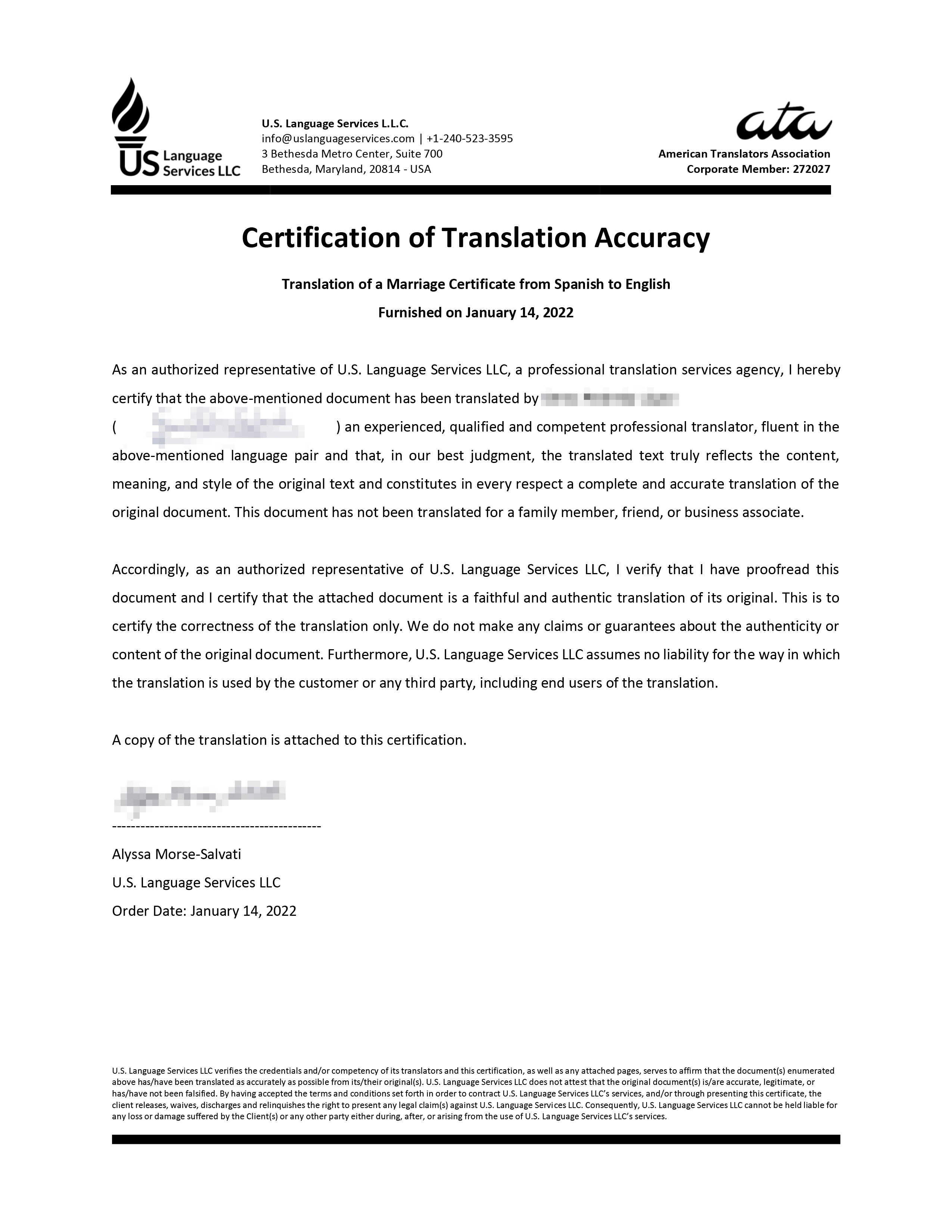
Beginning this new chapter also involves preparing and submitting important documentation. Depending on your background and the requirements of your state, you may need to provide educational transcripts, professional licenses, exam results, or personal documents such as birth certificates, marriage certificates, or visa records. To ensure these documents are accepted, certified translations are often necessary.
Professional translation services can help you meet these requirements accurately and efficiently, giving you confidence as you progress toward licensure. With the right preparation and support, you can successfully navigate the process and continue your career as an architect in the United States.
Order Your Certified Translation
U.S. Language Services is not a law firm; its content should not be taken as legal advice. For specific legal concerns, please consult a licensed attorney. Similarly, financial information on our site is for informational purposes only, not financial advice. Consult a certified financial advisor or tax professional for advice tailored to your situation.
By accessing U.S. Language Services, you acknowledge that it does not provide legal or financial advice. You agree not to rely on its content as such. U.S. Language Services and its contributors bear no liability for any inaccuracies, losses, or damages resulting from the use of information on our site.

Guaranteed Acceptance
All our certified to English translations are accepted by the USCIS. Our translations follow the guidelines established by the USCIS and are also accepted by educational institutions.
Most Requested Documents
FAQs
You can order most translations 24 hours a day, 7 days a week through our online store. For large projects (more than 20,000 words or 50 pages), please request a quote.
General Questions
Certified Translation
Standard Translation


American Translators Association
Corporate Member: M-101886
Get a free quote
Please provide us with your contact information and upload your documents. All the information transmitted is secure.