
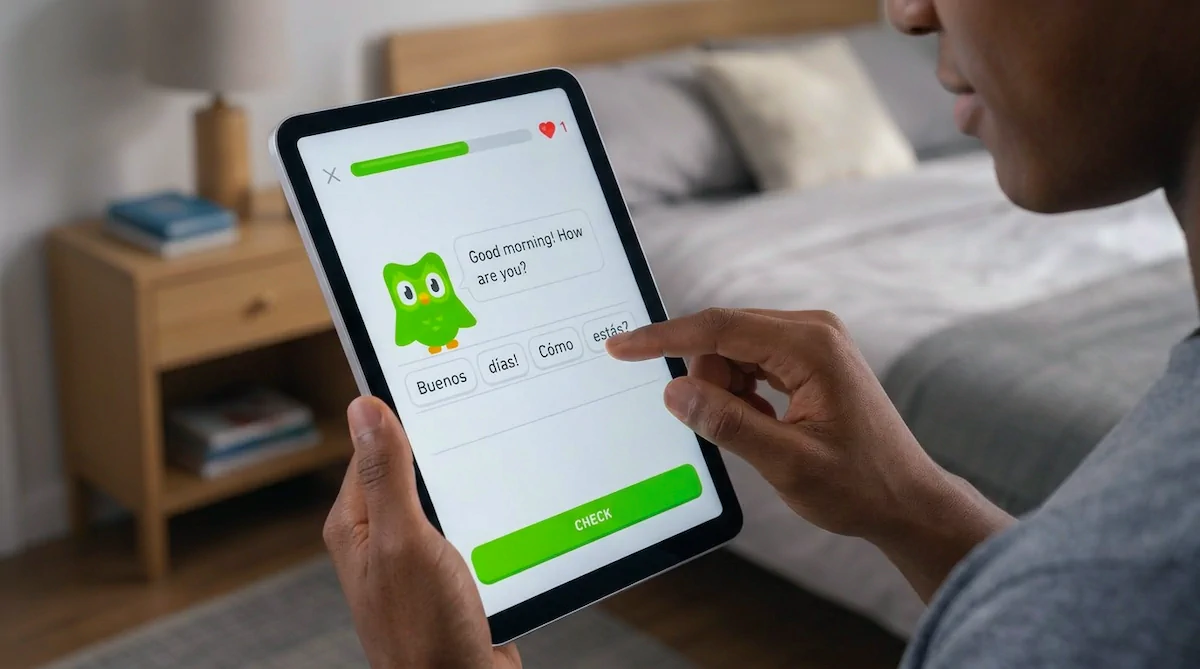
Few things feel as good as passing the one-year mark on a language-app streak. Finishing a Spanish, Russian, Italian, or Chinese lesson every night before bed has become a habit. We recognize hundreds of words and rarely miss an exercise. Part of that satisfaction and calm, though, comes from working in a controlled setting. Our brains already pick up on the patterns in the exercises, even when the vocabulary is new. More than once we’ve wondered: if I had to live one ordinary day of my life in that language, could I pull it off? Just thinking about it can make us uneasy. Daily life is full of surprises and random events that go well beyond ordering a coffee, and conversations that go well beyond the weather.
So while we work through another exercise on our phones, we might ask a different question: is an app, or an AI that can hold a conversation, enough to learn to speak another language?
Apps do teach, but what do they teach?
Two studies that Duolingo itself took part in offer a more interesting answer than a simple yes or no. To start with, rest easy: apps do teach, and that has been measured. The first, by company researchers and a scholar at Northern Arizona University, was published in the journal Foreign Language Annals. It evaluated 225 adults who were learning Spanish or French using only Duolingo. After finishing the beginner level, they read and understood audio about as well as university students at the end of their fourth semester. The study itself, however, points out a detail that app advertising tends to skip: it did not test speaking.
When speaking is measured, the results are more modest. In the second study, an internal company report, 66% of Spanish learners and 53% of French learners reached an A2 speaking level or higher after five units. On the European scale, A2 describes a basic user: someone who can introduce themselves, ask for directions, or describe their routine in simple sentences.
Speaking takes more than a big vocabulary
In the early 1980s, the linguist Michael Long proposed the interaction hypothesis: we learn mainly when we “negotiate” meaning with someone. Negotiating meaning is what happens when you don’t understand something, ask the other person to repeat it, and they rephrase it in different words. Shortly after, the linguist Merrill Swain added that learners also need to produce language, because trying to say something shows you exactly what you’re missing.
A typical app lesson mostly trains recognition: translate a sentence, put words in order, pick the right answer. A conversation, by contrast, requires you to improvise, interrupt, and repair a misunderstanding in real time. That’s how you can know plenty of words for ordering a coffee and still go blank when the barista asks whether you’d like to pay with points, since today only, points are worth double.
The promise of artificial intelligence
Chatbots built on large language models can hold a conversation, correct mistakes, and adjust to the user’s level. A 2025 meta-analysis of 41 studies on generative AI chatbots found a moderate to large positive effect on second-language learning. Other studies report less anxiety about speaking, which matters to anyone who feels embarrassed making mistakes in front of another person.
These results deserve a careful reading. First, almost all of those studies used AI within a teacher-led course, so they don’t measure what learners achieve with AI as their only tool. Second, the interventions usually last only a few weeks.
Scale is another issue. Studies of language apps tend to look at relatively short periods of use. The U.S. Foreign Service Institute estimates that an English speaker needs about 30 weeks of intensive training to speak Spanish at a professional level, with 23 hours of class and 17 hours of independent study each week. Keeping up that pace alone is hard.
As far as the published evidence goes, no study has documented adults starting from zero who reached fluent conversation using only apps or AI. That doesn’t prove it can’t be done. It means that, so far, no one has shown it.
Back to the bedtime lesson
If you’ve kept a one-year streak going with a language app before bed every night, don’t give it up! You’ve built vocabulary and learned to recognize structures, and, maybe even more important, you’ve built consistency and discipline.
Now use that streak to take the next step. Open yourself up to the human world of unpredictable conversations, shifts in speaking speed, and constant changes of topic.
Discovering the fascinating world of languages through an app gave us real skills. But let’s not forget that, as far as we know, people still master a language through conversation with others, in all its spontaneity, chaos, and creativity.