
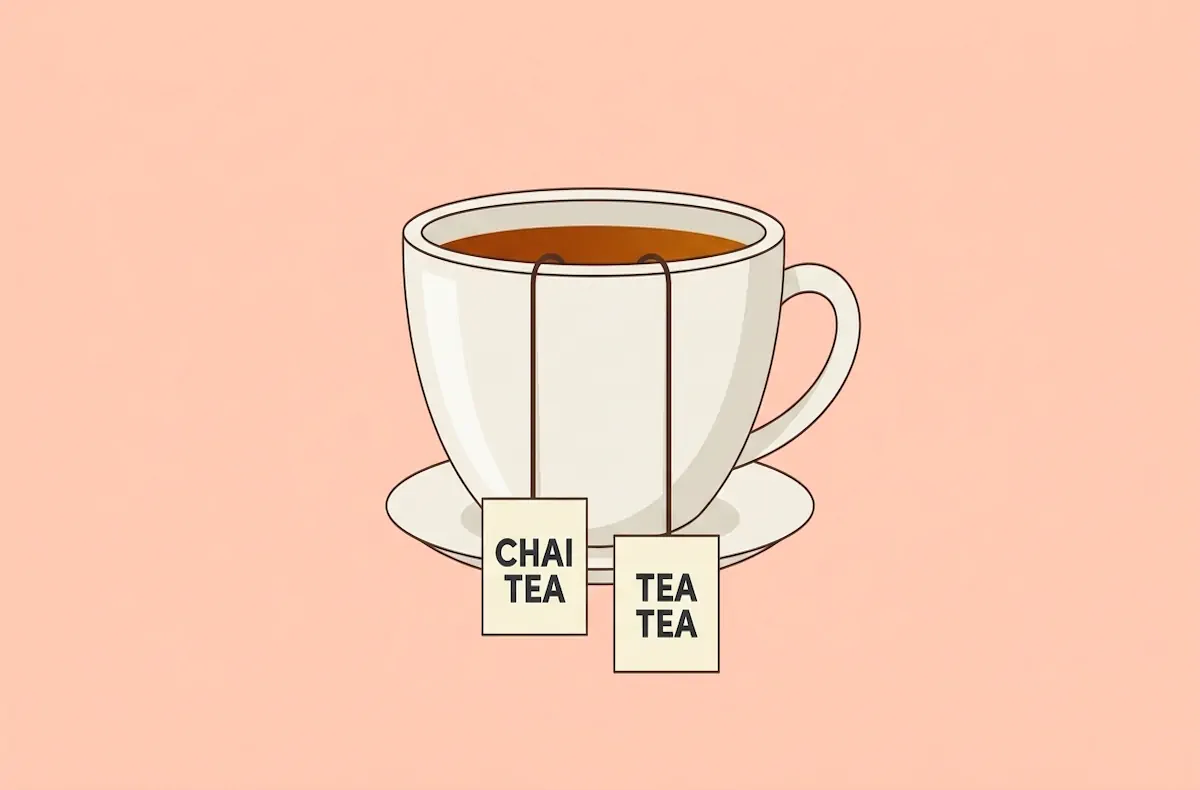
Have you ever ordered naan bread with your tikka masala or chai tea to go? If so, you’ve been repeating yourself more than you likely realize. Chai tea means tea tea, naan bread means bread bread, and the Sahara Desert means desert desert. Why do English speakers do this?
The answer comes down to the moments in history when English borrowed words. Over time, due to lack of exposure and gradual integration of new words, English can slip into bilingual redundancies that serve as fossils of the moment two cultures met. Duplicated terms are two halves of linguistic history hiding in plain sight.
Duplication as Modification
Consider the origins of terms such as “chai tea.” In Hindi, Urdu, Persian, and other languages of the region, chai or chay means “tea.” But nowadays, chai specifically refers to a drink made with black tea, milk, and spices. To add to that, the word “tea” itself traces back to Chinese, when the Dutch traded tea (or “te,” as per the pronunciation of the character) with the Min Chinese. These words have made contact with each other numerous times, and now, that duplication is serving not as a definition of the object, but as its modifier. If you order chai tea, you are expecting a specific type of tea.
Naan bread is another good example. The Persian nān means “bread,” and the word passed into Hindi and Urdu before finding a home in English, too. As with chai tea, English speakers who ask for naan bread are expecting a specific, recognizable type of bread. When someone makes you a sandwich, you do not anticipate that it will be made with naan. “Bread” and “naan bread” have become distinct.
This type of duplication doesn’t only happen with food. Take the Sahara Desert. The word ṣaḥrāʾ means “desert,” but over time, this word has undergone not only a meaning shift but also a functional shift. Sahara is now a proper noun, which means that it could be a person’s name (which it sometimes is!), a place, a building, or anything else. Thus, speakers have appended “desert” to clarify what this proper noun might refer to.
Why Modify?
If you already knew that Sahara meant desert, then why don’t you just say “Sahara”? Most people opt to repeat themselves by using the origin word plus the English word for specificity. As noted, asking for chai leaves you expecting a specific type of tea, and naan a specific type of bread. But there’s a linguistic reason, too.
English already had a word for tea and a word for bread. While language is adaptable, it tends to be resistant to change that does not lead to simplicity. In other words, it’s more complicated to replace the word “bread” with a different word for “bread” when the original already fulfills that linguistic need.
Speakers also become “blind” to the repetition of frequently used terms. You’ll see this in, for example, “PIN number” or “ATM machine,” where PIN means personal identification number and ATM means automated teller machine. This doesn’t require the introduction of foreign words where the meaning may originally have been unclear; instead, “PIN” functions as a clarifier, and “number” a specifier. What number are you looking for? A PIN number. Once people become accustomed to that phrase, they typically stop parsing its pieces. Thus, the fact that they are repeating “number” goes undetected (for most people).
Why Food?
You might have noticed that some of the most common examples of duplication involve foods and drinks. Historically, these items were more likely to be encountered and disseminated than concepts. Suppose that you are a trader hundreds or even thousands of years ago. When you purchase goods, are you more likely to encounter the word “naan” (i.e., a food, which you need for your journey to survive) or a foreign word for “number” (which could be bypassed entirely or gestured around)? These linguistic transfers often occurred around tangible, commonly used words, and few things are more ubiquitous across the human experience than food.
Just because English is dense with meaning does not mean that this repetition and linguistic adoption have stopped! That’s where PIN numbers, ATM machines, and VIN numbers come from. Language seeks specificity, and duplicated phrases like these provide it—even if they have to resort to repetition to do so.
