
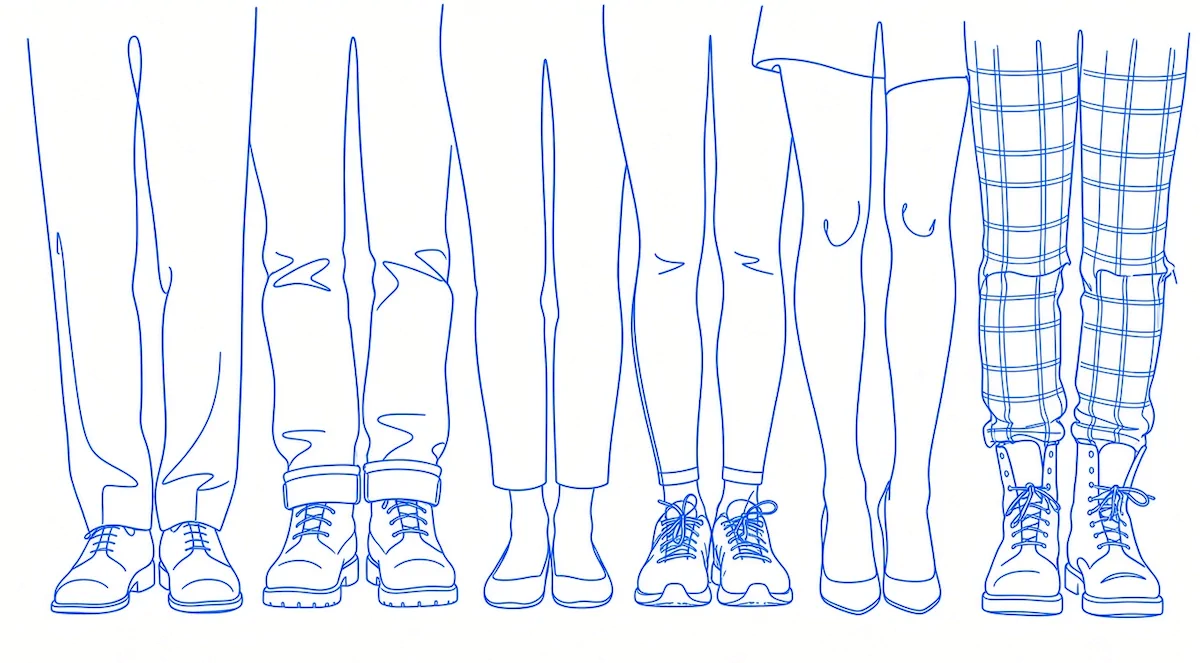
Read enough Sherlock Holmes, and you begin to realize that any good detective uses footwear as an important source of forensic evidence in an investigation.
The bloodhound from Baker Street could say much about people from their footprints or the mud on their shoes. Modern research has taken our understanding of what shoes reveal about their owners a step further.
A study from the University of Kansas suggests that, when it comes to first impressions, your footwear might be doing more work than you think. And that isn’t limited to what it says about your taste, like whether you prefer chic leather or something a bit more out there.
Given only pictures of shoes, subjects in the study could suss out details like the owner’s age, income, and even level of attachment anxiety.
The research offers a fascinating glimpse into how many cues people process to judge others in initial interactions.
A Lace-y Affair
One might think of footwear as the most humble element of any outfit. You’re quick to wash stains off a shirt or cover your dress in a raincoat, but your shoes rarely receive the same treatment. They’re left to brave the elements and are often judged by how well they take a beating.
Treated this way, our shoes begin to carry traces of our daily life: the surfaces we traverse most often, our physical activity, and much more.
Psychologists have a term for the traces of information we leave behind through our lifestyle and habits: behavioral residue. A well-worn pair of boots, polished oxfords, and tattered trainers all tell stories about how someone navigates the world.
So it’s no surprise that we subconsciously gather data about people based on the accessories adorning their feet.
Research Is Afoot
Now, back to the study. In 2012, a team led by University of Kansas psychologist Omri Gillath, with co-author Angela Bahns of Wellesley College, set out to learn how much we can tell about each other from our choice of footwear. Their starting point was that people make quick judgments about others based on surprisingly minimal appearance cues, which means we scan everything from crown to toe, including what’s on the toes.
The experiment setup was simple. One group of participants sent in photos of the shoes they wore most often. Another group was tasked with sizing up the people who wore them. On several counts, they did a surprisingly good job.
The group doing the judging was able to infer characteristics like gender, income range, age, and even more complex traits like attachment anxiety more accurately than chance would predict.
Some of these observations came from obvious visual cues. For example, women’s footwear generally looks markedly different from men’s. But some of the deeper insights came from subtler details like the degree of wear and signs of upkeep. Owners with higher attachment anxiety, for instance, tended to wear shoes that looked new and well kept.
The study doesn’t imply that shoes can tell you everything you want to know about someone. It is more a window into how people can use seemingly insignificant sources of information to make reasonably accurate judgments about others.
Beyond What’s Trending
Shoes are a useful element to study because they are such a stable part of our outfits.
The clothes we wear vary widely based on a number of factors. You might look at a weather report and decide to change what you’re going to wear to work. A particular kind of event can call for specific accessories.
Our footwear, on the other hand, rarely shows that much variation. Frequently worn pairs often gather the dust of our daily behaviors. The sole wears away differently depending on someone’s gait. Leather creases in ways that reflect how you move.
This may help explain why our shoes tell on us as much as they do. They become a canvas that records our repeated behaviors.
The Inner Lives of Everyday Objects
Much of human communication is nonverbal. Posture, eye contact, facial expressions, and gestures all play a key role in how messages are conveyed and received. This means that in any interaction, you’ve already said a lot about yourself even before you utter the first word.
We can now add footwear to that list of signals.
But a word of caution: first impressions can be well-informed, but they’re not perfect.
Someone might wear a particular pair of shoes only because they were a gift. The signs of wear you see could date from a time when someone was injured. Context always matters.
The broader takeaway is the many ways humans communicate and how our bodies and possessions become records of our daily lives. So before you judge someone by what they’re wearing, take a beat to walk a few steps in their shoes.
