
‘Fake news’ is a term that has gained prominence as a descriptor for the media environment that we find ourselves exposed to in contemporary times. It is a sort of umbrella term for outlets that publish news that’s sensationalist, fabricated, or designed to provoke outrage.
But before the term became so widely used in election speeches and podcasts, there was another name for the same phenomenon: yellow journalism.
The origins of the term go all the way back to the late 19th century, when two of New York’s most powerful newspapers locked horns over a character that wore a yellow nightshirt. This rivalry would give us the term yellow journalism and a rather amusing way to remember one of the most sensational eras in American journalism.
Meet The Yellow Kid
The aforementioned character, created by cartoonist Richard F. Outcault and made famous by Joseph Pulitzer’s New York World, first appeared in a comic called Hogan’s Alley. The comic depicted life in a crowded New York neighborhood and one of the primary characters in this setting eventually came to be known as the Yellow Kid.
The kid in the yellow nightshirt soon became such a pop culture phenomenon that people would buy copies of the World just to read the comic. Over time, the kid outgrew his status as a Sunday-page attraction, and some enterprising media bigwigs of the day began to notice.
More specifically, William Randolph Hearst, who had purchased the New York Journal around that time, saw how popular the Yellow Kid had made the World. So in 1896, he managed to poach Outcault away from the World and with him, the kid in the yellow nightshirt. Or at least that’s what he thought.
Not one to take such a move lying down, the World hired a cartoonist named George Luks to continue drawing Hogan’s Alley. And that’s how it came to be that different versions of the same comic strip began circulating in two of New York’s biggest newspapers. The Yellow Kid had become the protagonist of one of the fiercest media battles of its time.
From Newspaper to Entertainment Outlet
It’s important to understand the evolving media environment of the late 19th century to put this battle in context.
Newspaper publishers were responding to an industry in flux during this period. It was a time when publishing technology was improving rapidly, literacy rates were booming, and newspapers found themselves competing for a wider audience than they had ever envisioned before.
People like Joseph Pulitzer and William Randolph Hearst thus began to see the value of tactics that would have been frowned upon by the newspaper industry in earlier times. Tactics like enormous headlines, illustrations, dramatic stories, crime reports, scandals, and stories designed to provoke an immediate emotional response.
As a result, the Sunday editions of newspapers began to look more like entertainment publications than your run-of-the-mill newspaper.
The Yellow Kid was a media artifact uniquely suited to capitalize on the changing times. His popularity was evidence of a transition into an era dominated by images rather than words. The rivalry that was born out of competition for this character was a sign of just how far publishers were willing to go to get the attention of a growing audience.
Before long, there was a term for the papers associated with the melee around the Kid: “yellow” or “Yellow Kid” newspapers. The phrase “yellow journalism” came to describe a style of reporting that emphasized sensationalism over the sober and restrained representation of facts.
From Comics to Cuba
The term might have remained associated with a colorful period of New York newspaper lore, but it quickly moved beyond its original mandate. In fact, it became entangled with one of the biggest international stories of the decade.
The fin de siècle was a period during which Cuba was fighting back against its Spanish colonizers. The cause found widespread sympathy across the United States. And the newspapers were right there to catch the rising tide of public sentiment.
Both Hearst and Pulitzer assigned plenty of space in their newspapers to developments in the Cuban revolution.
Some of the stories coming out of Cuba were factual; others were, well, not quite. Much of the coverage during this time exaggerated or even fabricated happenings around the revolution. They were accompanied by dramatic illustrations that often depicted occurrences that never really happened.
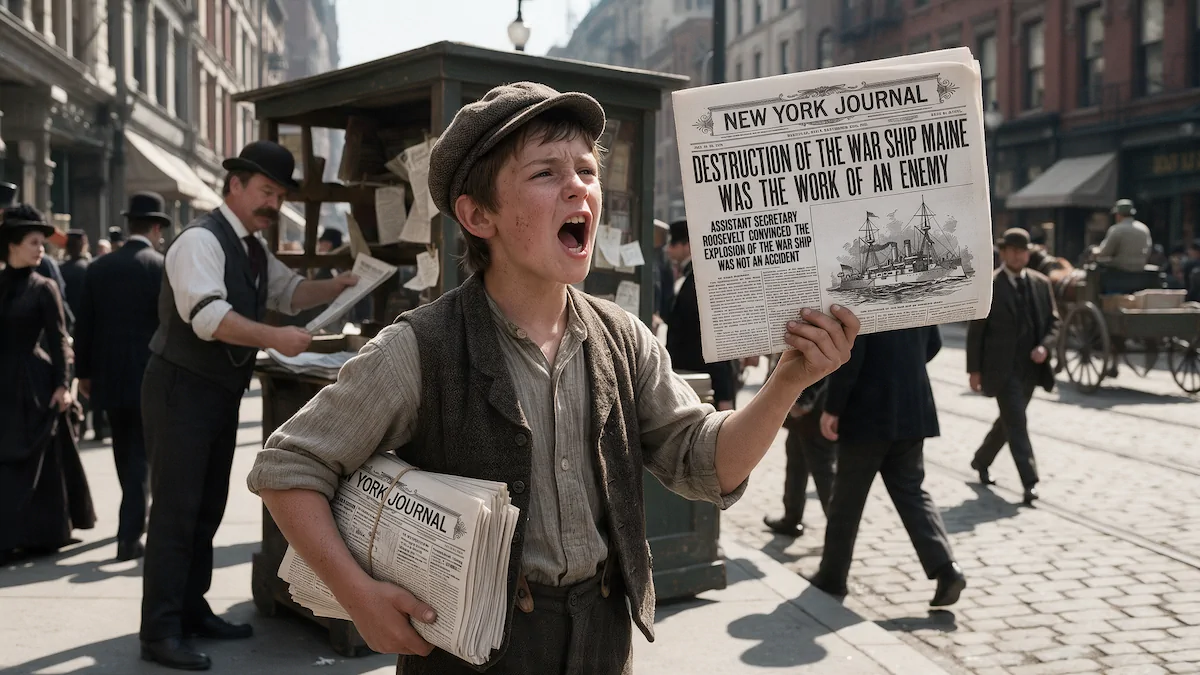
Playing fast and loose with the facts soon had dangerous consequences. On February 15, 1898 the USS Maine exploded in Havana Harbour, killing more than 260 American sailors and officers. The cause of the explosion was uncertain, but newspapers quickly began suggesting that Spain was responsible.
Even investigations conducted decades after the incident using advanced scientific methods weren’t able to establish that the Spaniards were behind what happened. Admiral Hyman G. Rickover commissioned experts to study documentation from the explosions in 1976 as part of research for his book, How the Battleship Maine Was Destroyed. The investigation concluded that the most likely cause was the spontaneous combustion of stored coal in an area adjoining the magazine, and not an external mine explosion.
Within months, the United States and Spain were engaged in battle. The U.S. Department of State explicitly notes that yellow journalism was one factor in the atmosphere surrounding the conflict.
The Seeds of Modern Journalism
The events in this story unfolded over a century ago and yet, they feel eerily familiar.
Developments in technology, media publications battling over public attention, and questionable journalistic practices leading to unfortunate consequences—these are all equally marks of the times that we live in.
Yellow journalism isn’t just a long-lost period in media history. It’s a watershed that revealed how the appetite for public attention and profits can divert the media from its role as the fourth estate of democracy.
Luks published his final episode featuring the Yellow Kid on December 5, 1897. Outcault wrapped up his run with the Kid a few weeks later, in January 1898. The lessons we’ve learned from this era of media history, however, live on.
