
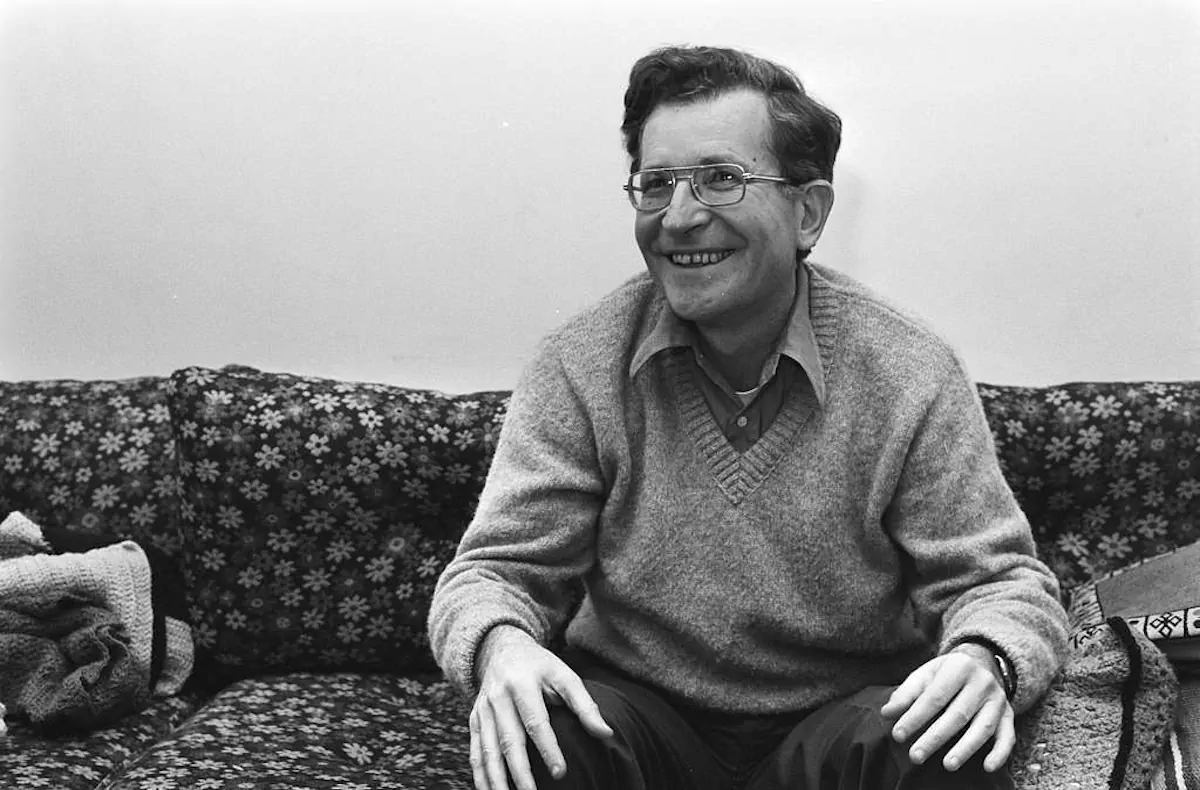
About Noam Chomsky
Born in Philadelphia in 1928, Noam Chomsky is one of the most influential figures in linguistics and a renowned intellectual.
Considered the father of modern generative linguistics, Chomsky has contributed to fields ranging from generative grammar and the theory of universal grammar to the cognitive revolution based on the study of mental processes. His work has had an enormous impact on philosophy and science, as well as on computer science through the “Chomsky Hierarchy,” which laid a foundation for designing and processing programming languages.
In addition to his extensive work as a linguist, he is also known as a political commentator and social activist, and is a professor emeritus at the Massachusetts Institute of Technology (MIT). His long-standing friendship and collaboration with Jeffrey Epstein came to light in 2023, and although he has not been implicated in the crimes committed by Epstein, both he and his wife, Valéria Chomsky, have publicly apologized.
Overview of the Theory of Universal Grammar
The theory of universal grammar is based on the idea that the human brain is innately equipped to develop a set of grammatical rules and structures. Language is not learned solely through experience but also through the biological foundation inherent in the human brain. Children therefore have an underlying framework to which different languages conform, making language acquisition easier without relying exclusively on prior external experience. The best-known real-world test of this idea came from Nicaragua, where a group of deaf children with no common language built a grammar of their own from scratch.
This theory not only explains how languages are learned from birth but also argues that, at a deeper level, the syntax of human languages is very similar.
Developed in the 1950s and 1960s, the theory of universal grammar has played a fundamental role in modern linguistics and in the research that followed.
The Chomsky Hierarchy and Its Relationship to Computer Science
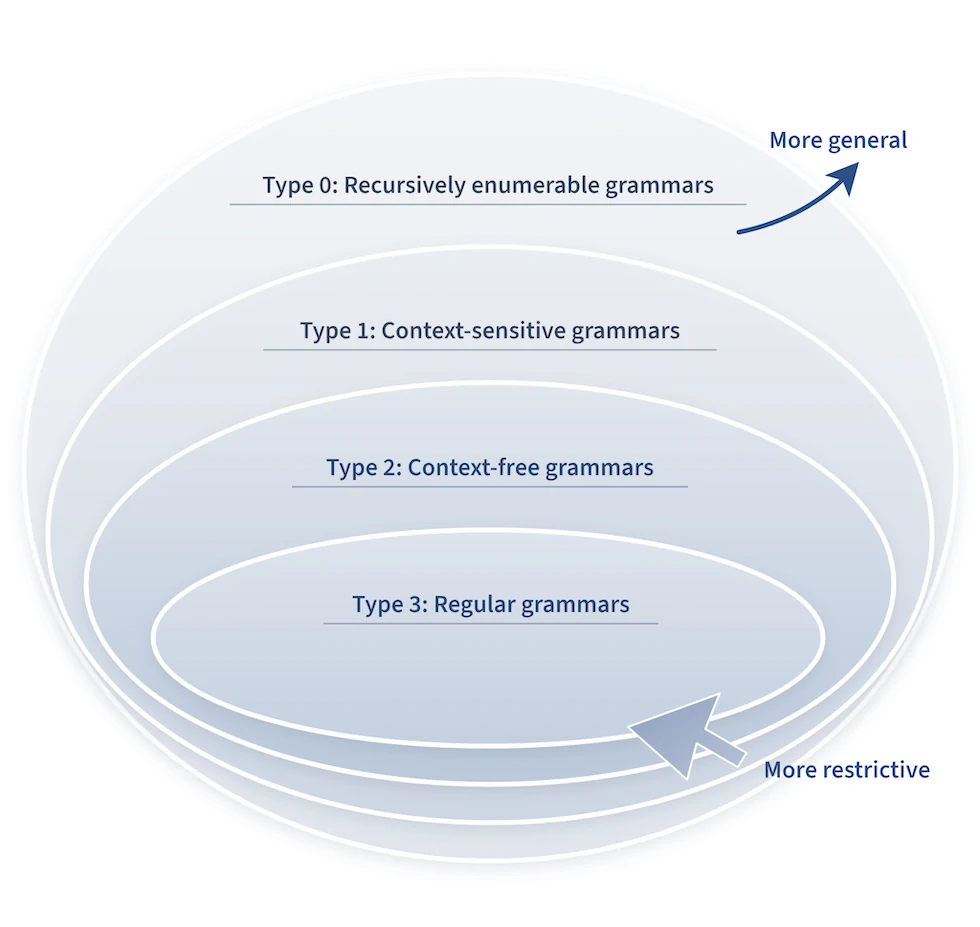
Described in September 1956 in the work Three models for the description of language, the “Chomsky Hierarchy” is a classification of formal languages according to the complexity of the grammars that describe them and the type of machine capable of recognizing them.
This hierarchy has been particularly important in computer science because it helped establish the theoretical foundations for designing lexical analyzers, parsers, and compilers, essential tools that allow an electronic device to process and execute code.
Before examining the levels of the “Chomsky Hierarchy” in detail, it is important to understand the following technology-related concepts:
- Formal language: a set of strings of symbols that follow syntactic rules determining whether they are correct and valid. Examples: binary language, arithmetic expressions.
- Formal grammar: a set of rules that defines the structure of a formal language and how valid strings are generated. Examples: programming language syntax.
- Automata: machines capable of recognizing strings of symbols and determining whether they belong to a formal language. Different types of automata exist depending on their complexity and processing capabilities. Examples: finite automaton, Turing machine.
The “Chomsky Hierarchy” establishes four levels, ordered from lowest to highest expressive power:
- Type 3, regular grammars
-
- They are the simplest.
-
- Regular expressions.
-
- Equivalent automaton: finite automaton.
- Type 2, context-free grammars
-
- They have hierarchical structures.
-
- Essential to the syntax of programming languages.
-
- Equivalent automaton: pushdown automaton.
- Type 1, context-sensitive grammars
-
- The rules depend on context.
-
- Equivalent automaton: linear bounded automaton.
- Type 0, unrestricted grammars
-
- They are the most general.
-
- Their rules have no restrictions.
-
- Turing machines.
Noam Chomsky’s Criticism of Large Language Models
Noam Chomsky is critical of the deep learning used by LLMs (large language models) in artificial intelligence. While these models rely on massive amounts of data and statistical usage patterns, Chomsky argues that humans possess innate rules that allow them to understand and formulate language. Those rules work alongside continuous exposure to information and experience.
According to this theory, LLMs analyze enormous volumes of data as part of their ongoing learning process without developing a formal understanding of structures and meanings. Therefore, they can generate grammatically correct text without actually understanding it or possessing a genuine representation of the world.
The development of these automated systems represents a particularly significant moment in human history, as today’s language models can take over tasks that used to require a person, from drafting text to summarizing information. This opens new avenues for research and debate about the role of artificial intelligence in human knowledge, how language can be generated, and how new forms of communication can emerge.