
Does largo mean large? Actualmente means actually, right? And librería? Must be library.
If you speak Spanish, or have studied it long enough, you know none of those are right. Largo means long, actualmente can mean currently, and a librería is a bookstore. None of these words set out to fool you. Still, if they were people, you’d call them false friends. They got your hopes up and then turned out to be something else.
That’s why linguists call these words false friends: words in two languages that look or sound alike but don’t mean the same thing. The term dates to 1928, when Maxime Koessler and Jules Derocquigny published a guide in Paris to help French translators, calling these words “betrayals” of English vocabulary. The name caught on, and English picked it up as false friends.
There’s a historical reason English and Spanish share so many of them. English is a Germanic language, but it absorbed a huge amount of vocabulary from Latin, the same source Spanish comes from. Over the centuries, those shared words changed separately in each language, and some meanings drifted so far apart that you’d never connect them today.
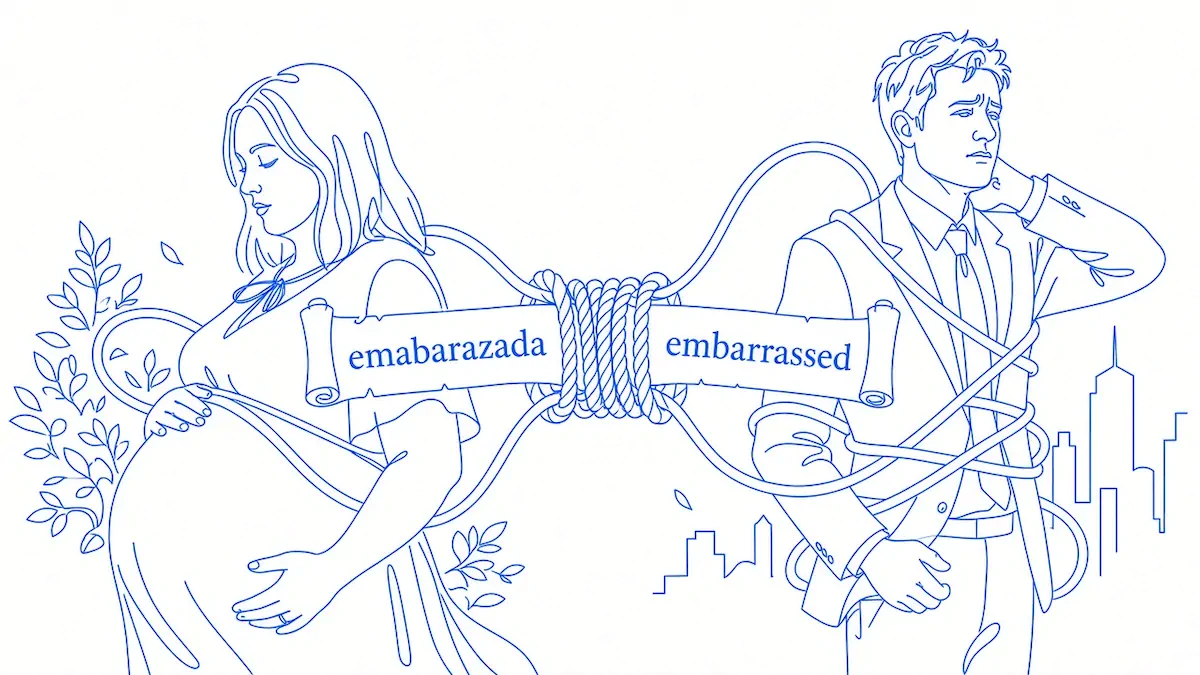
One of the funniest examples is embarazada, Spanish for “pregnant,” and its English look-alike, embarrassed. Both go back to baraça, a 13th-century Portuguese word for a “tie, cord, or rope.” Embaraçar meant “to tangle someone up in a rope,” which is why 14th-century Spanish used it to mean “to impede, hinder, or obstruct.” But the word kept traveling. It reached Italian as imbarazzo and then French as embarrasser, changing a little in each language along the way. In the 17th century, it crossed from French into English as embarrassed, meaning “perplexed.” The obstacle had moved into the mind. Someone who is perplexed is stuck and can’t see a way forward. By the 19th century, the English meaning had shifted from perplexity to a related feeling, the one we now call embarrassment. In Spanish, the word went another way, toward physical states rather than feelings. In the 16th century, embarazado stretched beyond “impeded or hindered from doing something” to cover other conditions that hamper you in a similar way, such as expecting a child, which makes everyday activities harder. Still, some of the English logic survives in Spanish, since something embarazoso is embarrassing.
Not all false friends are equally deceptive, though. Linguist Pedro José Chamizo Domínguez, author of one of the most thorough theoretical studies of the subject, divides them into total and partial false friends. Total false friends share no meaning at all. Éxito, which means “success,” has nothing to do with exit. Partial false friends overlap in some senses and part ways in others. Asistir lines up with assist when it means helping someone, but asistir a clase means to attend class.
The partial ones are the most treacherous, precisely because the match so often works, as with embarrassing and embarazoso. You get it right again and again, your confidence grows, and when you finally hit a context where the match breaks down, no alarm goes off.
Unfortunately, fluency in the other language won’t always protect you from false friends. In experiments, bilinguals are quicker to recognize words that look and mean the same in both languages. Words that look the same but mean something different don’t get that boost. Most researchers take this as a sign that the bilingual brain doesn’t switch one language off while using the other. Both meanings activate and compete.
False friends can also turn into real ones. In Spanish, bizarro traditionally means “brave” or “gallant.” The Real Academia Española, the body that sets standards for Spanish, notes in its Diccionario panhispánico de dudas that using bizarro to mean “strange” is a calque of the English or French bizarre, a meaning borrowed from another language. It adds that this use has become so widespread that it no longer objects to it. The Academy still objects, however, to realizar in the sense of “to become aware,” copied from the English realize. In standard Spanish, realizar means “to carry out.” And the Academia Mexicana de la Lengua, Mexico’s language academy, advises against using aplicar in place of solicitar, “to apply for,” while conceding that the usage is correctly formed.
Look-alike words aren’t going anywhere. Maybe, instead of treating them as a problem, we can put them to work. We don’t use language only to communicate clearly. We also use it to express ourselves and to play, and false friends earn their keep in jokes and literature, where writers create double meanings on purpose.
False friends are awkward, annoying, and embarrassing, but it’s up to us to slip free of the ropes their tricks have tied us up in.