

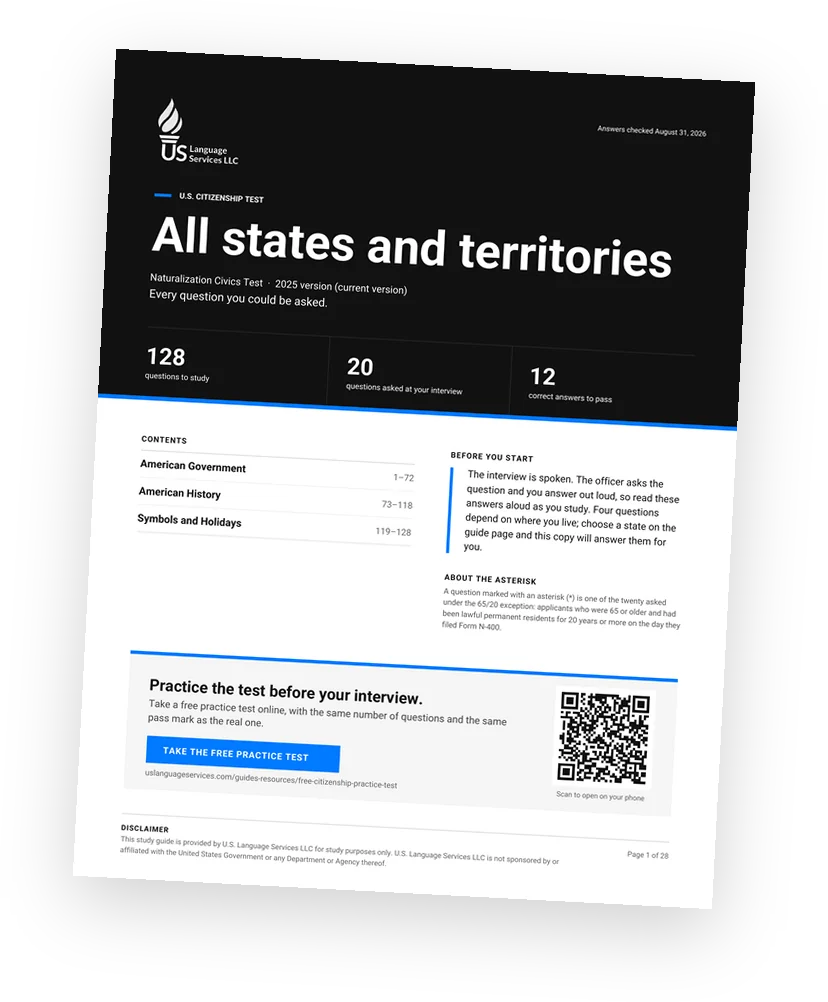
U.S. Citizenship Test Questions and Answers
Tell us a few things about yourself and we’ll show you the exact questions that apply to your case, with the answers for your state.
Your answers also update the list of questions below.
Section 1: American Government
72 questions
A: Principles of American Government
Answers: (Choose any of the following 3 options)
- Republic
- Constitution-based federal republic
- Representative democracy
Answers: (Choose any of the following 4 options)
- Forms the government
- Defines powers of government
- Defines the parts of government
- Protects the rights of the people
Answers: (Choose any of the following 5 options)
- Self-government
- Popular sovereignty
- Consent of the governed
- People should govern themselves
- (Example of) social contract
Answers: (Choose any of the following 2 options)
- Amendments
- The amendment process
Answers: (Choose any of the following 2 options)
- (The basic) rights of Americans
- (The basic) rights of people living in the United States
Answers: (Choose any of the following 4 options)
- It says America is free from British control.
- It says all people are created equal.
- It identifies inherent rights.
- It identifies individual freedoms.
Answers: (Choose any 2 of the following 6 options)
- Equality
- Liberty
- Social contract
- Natural rights
- Limited government
- Self-government
Answers: (Choose any of the following 2 options)
- Capitalism
- Free market economy
Answers: (Choose any of the following 4 options)
- Everyone must follow the law.
- Leaders must obey the law.
- Government must obey the law.
- No one is above the law.
Answers: (Choose any of the following 8 options)
- Declaration of Independence
- Articles of Confederation
- Federalist Papers
- Anti-Federalist Papers
- Virginia Declaration of Rights
- Fundamental Orders of Connecticut
- Mayflower Compact
- Iroquois Great Law of Peace
Answers: (Choose any of the following 3 options)
- So one part does not become too powerful
- Checks and balances
- Separation of powers
B: System of Government
Answers: (Choose any of the following 2 options)
- Legislative, executive, and judicial
- Congress, president, and the courts
Answers: (Choose any of the following 3 options)
- (U.S.) Congress
- (U.S. or national) legislature
- Legislative branch
Answers: (Choose any of the following 3 options)
- Writes laws
- Declares war
- Makes the federal budget
Answers: (Choose any of the following 2 options)
- Equal representation (for small states)
- The Great Compromise (Connecticut Compromise)
Answers: (Choose any of the following 2 options)
- Citizens of their state
- People of their state
Answers: (Choose any of the following 4 options)
- Citizens in their (congressional) district
- Citizens in their district
- People from their (congressional) district
- People in their district
Answers: (Choose any of the following 3 options)
- (Because of) the state’s population
- (Because) they have more people
- (Because) some states have more people
Answers: (Choose any of the following 2 options)
- (Because of) the 22nd Amendment
- To keep the president from becoming too powerful
Answers: (Choose any of the following 6 options)
- Signs bills into law
- Vetoes bills
- Enforces laws
- Commander in Chief (of the military)
- Chief diplomat
- Appoints federal judges
Answers: (Choose any of the following 3 options)
- President (of the United States)
- Cabinet
- Federal departments and agencies
Answers: (Choose any 2 of the following 22 options)
- Attorney General
- Secretary of Agriculture
- Secretary of Commerce
- Secretary of Education
- Secretary of Energy
- Secretary of Health and Human Services
- Secretary of Homeland Security
- Secretary of Housing and Urban Development
- Secretary of the Interior
- Secretary of Labor
- Secretary of State
- Secretary of Transportation
- Secretary of the Treasury
- Secretary of Veterans Affairs
- Secretary of War (Defense)
- Vice-President
- Administrator of the Environmental Protection Agency
- Administrator of the Small Business Administration
- Director of the Central Intelligence Agency
- Director of the Office of Management and Budget
- Director of National Intelligence
- United States Trade Representative
Answers: (Choose any of the following 2 options)
- It decides who is elected president.
- It provides a compromise between the popular election of the president and congressional selection.
Answers: (Choose any of the following 2 options)
- Supreme Court
- Federal Courts
Answers: (Choose any of the following 4 options)
- Reviews laws
- Explains laws
- Resolves disputes (disagreements) about the law
- Decides if a law goes against the (U.S.) Constitution
Answers: (Choose any of the following 3 options)
- (For) life
- Lifetime appointment
- (Until) retirement
Answers: (Choose any of the following 2 options)
- To be independent (of politics)
- To limit outside (political) influence
Answers: (Choose any of the following 6 options)
- Print paper money
- Mint coins
- Declare war
- Create an army
- Make treaties
- Set foreign policy
Answers: (Choose any of the following 5 options)
- Provide schooling and education
- Provide protection (police)
- Provide safety (fire departments)
- Give a driver’s license
- Approve zoning and land use
C: Rights and Responsibilities
Answers: (Choose any of the following 4 options)
- Citizens eighteen (18) and older (can vote).
- You don’t have to pay (a poll tax) to vote.
- Any citizen can vote. (Women and men can vote.)
- A male citizen of any race (can vote).
Answers: (Choose any of the following 3 options)
- Citizens
- Citizens of the United States
- U.S. citizens
Answers: (Choose any 3 of the following 6 options)
- Freedom of expression
- Freedom of speech
- Freedom of assembly
- Freedom to petition the government
- Freedom of religion
- The right to bear arms
Answers: (Choose any of the following 2 options)
- The United States
- The flag
Answers: (Choose any 2 of the following 6 options)
- Give up loyalty to other countries
- Defend the (U.S.) Constitution
- Obey the laws of the United States
- Serve in the military (if needed)
- Serve (help, do important work for) the nation (if needed)
- Be loyal to the United States
Answers: (Choose any of the following 3 options)
- Be born in the United States, under the conditions set by the 14th Amendment
- Naturalize
- Derive citizenship (under conditions set by Congress)
Answers: (Choose any 2 of the following 10 options)
- Vote
- Run for office
- Join a political party
- Help with a campaign
- Join a civic group
- Join a community group
- Give an elected official your opinion (on an issue)
- Contact elected officials
- Support or oppose an issue or policy
- Write to a newspaper
Answers: (Choose any of the following 6 options)
- Vote
- Pay taxes
- Obey the law
- Serve in the military
- Run for office
- Work for local, state, or federal government
Answers: (Choose any of the following 4 options)
- Required by law
- All people pay to fund the federal government
- Required by the (U.S.) Constitution (16th Amendment)
- Civic duty
Answers: (Choose any of the following 3 options)
- Required by law
- Civic duty
- Makes the draft fair, if needed
Section 2: American History
46 questions
A: Colonial Period and Independence
Answers: (Choose any of the following 5 options)
- Freedom
- Political liberty
- Religious freedom
- Economic opportunity
- Escape persecution
Answers: (Choose any of the following 2 options)
- American Indians
- Native Americans
Answers: (Choose any of the following 2 options)
- Africans
- People from Africa
Answers: (Choose any of the following 3 options)
- American Revolution
- The (American) Revolutionary War
- War for (American) Independence
Answers: (Choose any of the following 10 options)
- High taxes
- Taxation without representation
- British soldiers stayed in Americans’ houses (boarding, quartering)
- They did not have self-government
- Boston Massacre
- Boston Tea Party (Tea Act)
- Stamp Act
- Sugar Act
- Townshend Acts
- Intolerable (Coercive) Acts
Answers: (Choose any of the following 6 options)
- (Battle of) Bunker Hill
- Declaration of Independence
- Washington Crossing the Delaware (Battle of Trenton)
- (Battle of) Saratoga
- Valley Forge (Encampment)
- (Battle of) Yorktown (British surrender at Yorktown)
Answers: (Choose any 5 of the following 13 options)
- New Hampshire
- Massachusetts
- Rhode Island
- Connecticut
- New York
- New Jersey
- Pennsylvania
- Delaware
- Maryland
- Virginia
- North Carolina
- South Carolina
- Georgia
Answers: (Choose any of the following 4 options)
- (James) Madison
- (Alexander) Hamilton
- (John) Jay
- Publius
Answers: (Choose any of the following 2 options)
- They helped people understand the (U.S.) Constitution.
- They supported passing the (U.S.) Constitution.
Answers: (Choose any of the following 5 options)
- Founded the first free public libraries
- First Postmaster General of the United States
- Helped write the Declaration of Independence
- Inventor
- U.S. diplomat
Answers: (Choose any of the following 4 options)
- “Father of Our Country”
- First president of the United States
- General of the Continental Army
- President of the Constitutional Convention
Answers: (Choose any of the following 6 options)
- Writer of the Declaration of Independence
- Third president of the United States
- Doubled the size of the United States (Louisiana Purchase)
- First Secretary of State
- Founded the University of Virginia
- Writer of the Virginia Statute on Religious Freedom
Answers: (Choose any of the following 4 options)
- “Father of the Constitution”
- Fourth president of the United States
- President during the War of 1812
- One of the writers of the Federalist Papers
Answers: (Choose any of the following 5 options)
- First Secretary of the Treasury
- One of the writers of the Federalist Papers
- Helped establish the First Bank of the United States
- Aide to General George Washington
- Member of the Continental Congress
B: 1800s
Answers: (Choose any of the following 2 options)
- Louisiana Territory
- Louisiana
Answers: (Choose any of the following 4 options)
- War of 1812
- Mexican-American War
- Civil War
- Spanish-American War
Answers: (Choose any of the following 8 options)
- (Battle of) Fort Sumter
- Emancipation Proclamation
- (Battle of) Vicksburg
- (Battle of) Gettysburg
- Sherman’s March
- (Surrender at) Appomattox
- (Battle of) Antietam/Sharpsburg
- Lincoln was assassinated.
Answers: (Choose any of the following 5 options)
- Freed the slaves (Emancipation Proclamation)
- Saved (or preserved) the Union
- Led the United States during the Civil War
- 16th president of the United States
- Delivered the Gettysburg Address
Answers: (Choose any of the following 4 options)
- Freed the slaves
- Freed slaves in the Confederacy
- Freed slaves in the Confederate states
- Freed slaves in most Southern states
Answers: (Choose any of the following 4 options)
- After the Civil War
- During Reconstruction
- (With the) 15th Amendment
- 1870
Answers: (Choose any of the following 6 options)
- Susan B. Anthony
- Elizabeth Cady Stanton
- Sojourner Truth
- Harriet Tubman
- Lucretia Mott
- Lucy Stone
C: Recent American History and Other Important Historical Information
Answers: (Choose any of the following 5 options)
- World War I
- World War II
- Korean War
- Vietnam War
- (Persian) Gulf War
Answers: (Choose any of the following 3 options)
- Because Germany attacked U.S. (civilian) ships
- To support the Allied Powers (England, France, Italy, and Russia)
- To oppose the Central Powers (Germany, Austria-Hungary, the Ottoman Empire, and Bulgaria)
Answers: (Choose any of the following 3 options)
- 1920
- After World War I
- (With the) 19th Amendment
Answers: (Choose any of the following 2 options)
- The Great Crash (1929)
- Stock market crash of 1929
Answers: (Choose any of the following 4 options)
- (Bombing of) Pearl Harbor
- Japanese attacked Pearl Harbor
- To support the Allied Powers (England, France, and Russia)
- To oppose the Axis Powers (Germany, Italy, and Japan)
Answers: (Choose any of the following 4 options)
- General during World War II
- President at the end of (during) the Korean War
- 34th president of the United States
- Signed the Federal-Aid Highway Act of 1956 (Created the Interstate System)
Answers: (Choose any of the following 3 options)
- Soviet Union
- USSR
- Russia
Answers: (Choose any of the following 2 options)
- Communism
- Nuclear war
Answers: (Choose any of the following 3 options)
- Fought for civil rights
- Worked for equality for all Americans
- Worked to ensure that people would “not be judged by the color of their skin, but by the content of their character”
Answers: (Choose any of the following 4 options)
- Terrorists attacked the United States
- Terrorists took over two planes and crashed them into the World Trade Center in New York City
- Terrorists took over a plane and crashed into the Pentagon in Arlington, Virginia
- Terrorists took over a plane originally aimed at Washington, D.C., and crashed in a field in Pennsylvania
Answers: (Choose any of the following 3 options)
- (Global) War on Terror
- War in Afghanistan
- War in Iraq
Answers: (Choose any of the following 25 options)
- Apache
- Blackfeet
- Cayuga
- Cherokee
- Cheyenne
- Chippewa
- Choctaw
- Creek
- Crow
- Hopi
- Huron
- Inupiat
- Lakota
- Mohawk
- Mohegan
- Navajo
- Oneida
- Onondaga
- Pueblo
- Seminole
- Seneca
- Shawnee
- Sioux
- Teton
- Tuscarora
Answers: (Choose any of the following 7 options)
- Light bulb
- Automobile (cars, internal combustion engine)
- Skyscrapers
- Airplane
- Assembly line
- Landing on the moon
- Integrated circuit (IC)
Section 3: Symbols and Holidays
10 questions
A: Symbols
Answers: (Choose any of the following 2 options)
- New York (Harbor)
- Liberty IslandNote: Also acceptable are New Jersey, near New York City, and on the Hudson (River).
Answers: (Choose any of the following 2 options)
- (Because there were) 13 original colonies
- (Because the stripes) represent the original colonies
Answers: (Choose any of the following 3 options)
- (Because there is) one star for each state
- (Because) each star represents a state
- (Because there are) 50 states
Answers: (Choose any of the following 2 options)
- Out of many, one
- We all become one
B: Holidays
Answers: (Choose any of the following 2 options)
- A holiday to celebrate U.S. independence (from Britain)
- The country’s birthday
Answers: (Choose any 3 of the following 11 options)
- New Year’s Day
- Martin Luther King, Jr. Day
- Presidents Day (Washington’s Birthday)
- Memorial Day
- Juneteenth
- Independence Day
- Labor Day
- Columbus Day
- Veterans Day
- Thanksgiving Day
- Christmas Day
Answers: (Choose any of the following 2 options)
- A holiday to honor people in the (U.S.) military
- A holiday to honor people who have served (in the U.S. military)
Study guide only. U.S. Language Services LLC is not sponsored by or affiliated with the United States Government or any Department or Agency thereof, including USCIS. Questions from the official USCIS lists.
Documents in another language? USCIS needs a certified English translation.
Common questions about the civics test
How many questions are on the citizenship test?
It depends on your version. If you filed Form N‑400 on or after October 20, 2025, you study 128 questions, the officer asks up to 20, and you need 12 correct to pass. If you filed before, you study 100, the officer asks up to 10, and you need 6 correct. The officer stops as soon as the result is decided.
Which version of the civics test will I take?
The date you filed Form N‑400 decides it, not the date of your interview. Filed on or after October 20, 2025: the 2025 test. Filed before: the 2008 test. Your filing date is in the “Received Date” box of your Form I‑797C receipt notice.
How does the civics test work?
It is spoken. On the day of your citizenship interview the officer reads each question aloud and you answer aloud: nothing is written down and there is no multiple choice. The same day you also take the English test, which checks that you can read, write, speak and understand English.
What is the 65/20 exception?
If, on the day you filed, you were 65 or older and had been a lawful permanent resident for periods totaling at least 20 years, you only study the 20 questions marked with an asterisk. The officer asks up to 10 of them and you need 6 correct. Both conditions have to be true; being 65 is not enough on its own.
Can I take the civics test in my own language?
Yes, if you qualify for one of the language exceptions: 50 or older with 20 years as a permanent resident, 55 or older with 15 years, or the 65/20 exception. You skip the English test and take the civics test in your language, with an interpreter you bring. See USCIS exceptions and accommodations.
Will I need any documents for the civics test?
You don’t need any documents specifically for the civics test. The purpose of the test is that you will have the above questions and answers memorized so that you don’t need written help.
However, as noted at the beginning of this guide, your civics test will take place on the same day as your citizenship interview. For that interview you’ll need all the documents required to go along with your N-400, Application for Naturalization. Some common documents needed for the N-400 are a copy of your green card, marriage certificates, or death certificates.
Should my documents be translated into English?
Yes, according to USCIS, if you submit a document with information in a foreign language, you must also submit an English translation.To guarantee that your naturalization application is processed quickly, it helps to use a certified translation.
Some documents that commonly need to be translated for immigration purposes include:
- Criminal records
- Birth certificates
- Military service records
- Marriage certificates
- Divorce decrees
- Academic transcripts
U.S. Language Services is not a law firm; its content should not be taken as legal advice. For specific legal concerns, please consult a licensed attorney. Similarly, financial information on our site is for informational purposes only, not financial advice. Consult a certified financial advisor or tax professional for advice tailored to your situation.
By accessing U.S. Language Services, you acknowledge that it does not provide legal or financial advice. You agree not to rely on its content as such. U.S. Language Services and its contributors bear no liability for any inaccuracies, losses, or damages resulting from the use of information on our site.

Guaranteed Acceptance
All our certified to English translations are accepted by the USCIS. Our translations follow the guidelines established by the USCIS and are also accepted by educational institutions.
FAQs
You can order most translations 24 hours a day, 7 days a week through our online store. For large projects (more than 20,000 words or 50 pages), please request a quote.
General Questions
Certified Translation
Standard Translation


American Translators Association
Corporate Member: M-101886
Get a free quote
Please provide us with your contact information and upload your documents. All the information transmitted is secure.