
Law firm case study
Sixteen hearings in two weeks: filing multilingual evidence on time
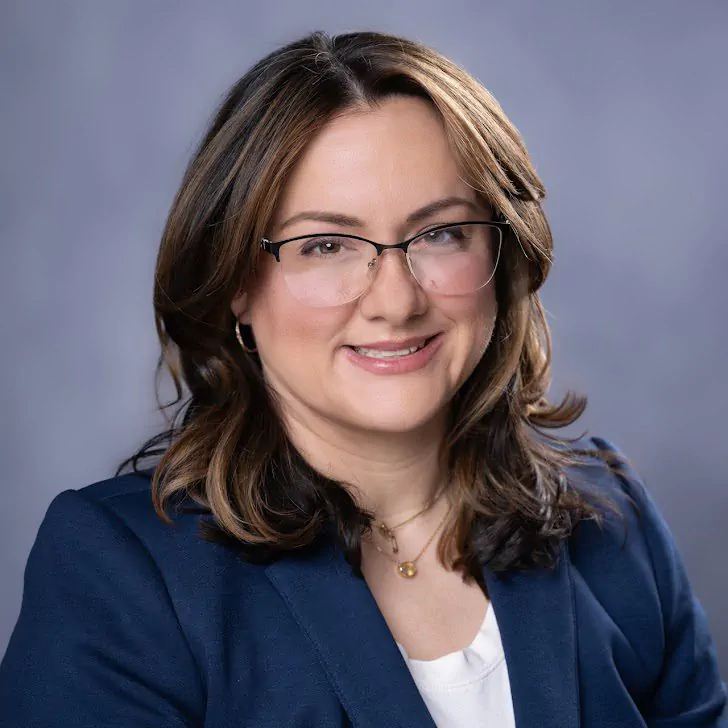
Emily A. Bendana-McHaleImmigration attorney and owner
- Client
- Law Offices of Emily A. Bendana-McHale, LLC
- Sector
- Law firms
- Client since
- 2022
- Work
- Immigration, plus related family and municipal matters
- Documents
- Evidence packets and supporting documents for immigration filings
- Languages
- Spanish, Italian, Ukrainian, Haitian Creole, French
- Filed with
- USCIS and immigration courts
Working to a hearing date?
Send the documents and the deadline. We confirm turnaround the same business day.
Law Offices of Emily A. Bendana-McHale, LLC
Emily Bendana is an immigration attorney and, since early 2026, the sole owner of her firm. Her caseload does not wait for her to settle in. In one recent stretch, she had sixteen hearings scheduled inside two weeks. Alone.
Her firm does no advertising. Every client arrives by word of mouth, and lately they arrive faster than ever. Many are detained. When someone is detained, their court date accelerates, and their case jumps the line, which means the evidence has to be ready almost immediately.
"We have very limited time to obtain evidence, get statements, and then have that stuff translated," she says. "It's a little crazy these days."
Where translation can sink a case
Immigration law runs on a rule that surprises people outside it: the burden of proof sits on the applicant. The government can hold back. Emily's clients cannot.
"A lot of the times, as defense attorneys, we're producing that information to the government for the first time," she explains. "We're the ones saying, this is who this person is, this is where they're from, this is why they're here."
And the courts read every document against the regulations. Was it certified properly? Is the address there? Is it signed? A translation that misses a procedural requirement can be excluded, and an excluded document can decide a case. Because children are derivatives of a parent's case, losing one case can mean three, four, or five people lose their future in the United States at once.
What changed in 2026
The rules have tightened. Evidence now has to be filed together with the application itself. And translation work her office once handled in-house must all be outsourced.
The rules have tightened, too. Evidence now has to be filed together with the application itself. And translation work her office once handled in-house is off the table entirely.
"As attorneys, we're no longer allowed to do any translating," Emily says. "Normally, the basic passports, birth certificates, we would just do to kind of help move it along with the clients. That's no longer allowed, so every document has to be outsourced."
"It's a zero sum game," she adds. "That's that person's future in the United States. Whether or not they'd be able to stay, whether or not their family members would be able to stay."
What she needed from a translation partner
Emily's client community speaks many languages, and often more than one per family. Her Haitian clients frequently speak Spanish with her while their documents are in French. She has sent us work in five languages, several in both directions.
"It's so helpful to have everything in one place," she says. "It's actually very difficult to find translators outside of the Spanish language. We already have one person, we have their history, we have their story, we have their trust, and that person now doesn't want to have to go to somebody else."
She has seen what happens when the language work goes wrong. In court, interpreters who don't speak a client's dialect, or who address Ukrainian speakers in Russian, do more than put the outcome at risk.
"It really isolates the client. It makes them feel like nobody's understanding them. One of the things we talk about internally is what does a win mean? It's not always just winning the case. It's having somebody heard."
How we work together
Nearly every project Emily sends runs through Anthony, her project manager at U.S. Language Services since 2022. Her communication style is deliberately spare: a set of documents and a date.
"I'm very direct. I use limited words. We need this by this date. And he always receives the communication. We get what we need."
That date is usually a hearing or a court-imposed submission deadline, with no room to negotiate, and Emily still needs time on her end to review the translations with her client before filing. So the turnaround has to leave that margin. And when a submission spans many files and formats, Anthony keeps track of every piece, so nothing needs a second request when the deadline is close.
The billing fits the way her firm runs, too. Projects are paid by the job, so a changed card or a shifted budget never tangles an account, and when a client is paying directly, she can send them the payment link and step out of the middle.
"We can pay by the job, so if things change, I don't have to go back and refix everything."
A 10,000-word filing
In June 2026, Emily sent us the largest project in a relationship that began in 2022: a single filing of more than 10,000 words, roughly ten times her usual volume. The client was a woman whose family members had already been granted asylum. She was the only one whose status was still undecided, and she has serious medical conditions under active treatment. Everything rested on this submission.
The size of the project changed nothing about how it ran.
"You guys were still responsive. The response was quick," Emily says. "On what you produced, yes, it was very helpful."
Two firms, one vendor
Emily started sending us work before she opened her own practice. When her longtime law partner passed away and she suddenly had a firm to run on top of a full immigration caseload, she kept every account exactly where it was.
"There was never a question," she says of continuing to work with us.
"It was very, very helpful to be able to continue the relationships and have smooth transitions."
Asked what she would tell another attorney considering us, she doesn't hedge.
"Absolutely. You're responsive, the documents are produced properly, the information is correct."
For a practice where a missed deadline or a faulty certification can cost a family its future in this country, that is the whole job description.
Certified translations for law firms and legal processes
35 Languages Supported
We translate to and from English










FAQs
You can order most translations 24 hours a day, 7 days a week through our online store. For large projects (more than 20,000 words or 50 pages), please request a quote.
General Questions
Certified Translation


American Translators Association
Corporate Member: M-101886
Get a free quote
Please provide us with your contact information and upload your documents. All the information transmitted is secure.