
Law firm case study
Keeping family petition translations consistent in eight languages
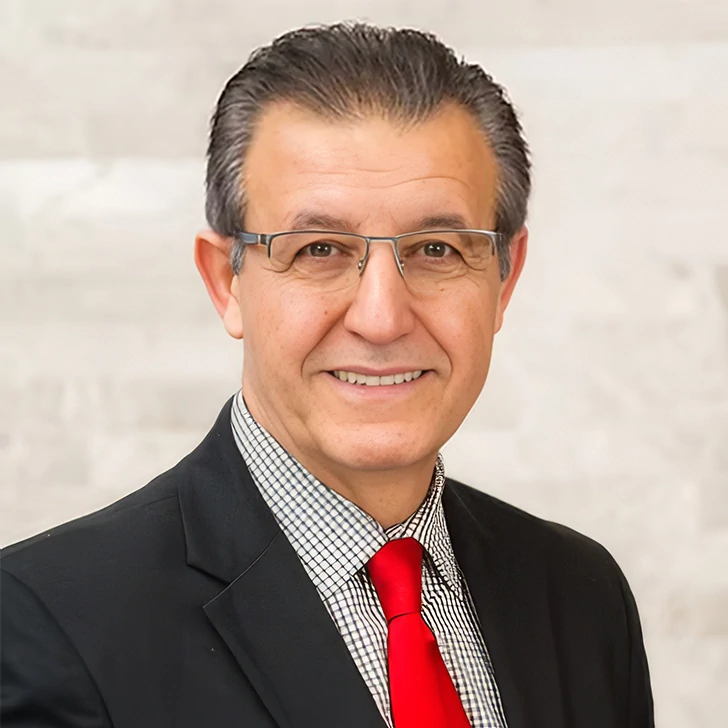
Rateb "Ron" KhasawnehImmigration attorney and owner
- Client
- Khasawneh & Associates LLC
- Sector
- Law firms
- Client since
- 2021
- Work
- Immigration, plus domestic and general practice
- Documents
- Civil registry documents for family petitions
- Languages
- Spanish, Arabic, French, Turkish, Portuguese, Urdu, Italian, Ukrainian
- Filed with
- USCIS
Assembling a family petition?
Send the documents and the filing date. We confirm turnaround the same business day.
Khasawneh & Associates LLC
Ron Khasawneh has never advertised. A name in the Yellow Pages, and nothing since. Every client his Columbus firm has taken on since the early 2000s arrived by word of mouth, and they have arrived from nearly everywhere.
"I would be highly surprised if you name a country that I haven't had a client from there," he says.
About ninety percent are local, from Columbus or elsewhere in Ohio, with a scattering in Baltimore, Pennsylvania, Chicago, Detroit, California. Immigration is the bulk of the practice, family petitions most of all, with domestic matters second.
When one name has two spellings
Clients arrive carrying whatever their home country issued them: birth certificates, marriage certificates, national ID cards, sometimes newspaper articles supporting an asylum claim. About half already know they will need English versions. The other half find out in his office.
Most of that work supports family petitions, which are filings to bring over a spouse, a parent, or a child. For those, the documents have to agree with one another.
Names written in another script have no single fixed spelling in English. The name Ron encounters most often, he says, is Mohammed, and it is also the one that varies most.
"How many different ways is it spelled? So if they bring me a birth certificate, for instance, and their name is M-U-H, and then we have a divorce certificate or a marriage certificate, now the name is spelled M-O-H."
Both versions are correct. Ron standardizes anyway. "We wanna try to make them consistent." A file carrying two spellings can be read as describing two different people, and he has had exactly that argument. "I've run into that and some serious issues where they were like, ‘No, that's not the same,’” he says. He has ended up sorting it out himself: "I had to give them, like, a short lesson in linguistics."
Why we ask for preferred spellings
Before translation begins, we confirm how each name should appear in English, and that spelling carries across every document in the set. It costs a minute at the start, and it keeps a file from presenting two versions of the same person.
How the work reaches us
Day to day, the work runs through the firm's assistants, who have handled it since 2021. Ron sees the translations when he reviews a file.
A new family petition takes roughly two weeks to assemble, between collecting documents, preparing the filing, and getting the client back in to sign. Translations have to land inside that window.
Billing runs the same way. When a client can pay on their own, we invoice them directly and the firm stays out of the transaction. "I don't mark it up. I don't charge them extra to what you guys charge," Ron says. When a client has no bank account or credit card, the office handles it for them instead.
Two providers, then one
Before 2021, the firm sent its translation work to two established language companies in Columbus. Someone in the office found us, and the comparison did not take long.
"Absolutely more efficient. The communication line is clear and easy. You guys never ignore things. You respond right away. And the timing is great. So we've been exclusively using you."
The firm has not sent a document anywhere else since. Asked what has kept it going, he kept the answer practical: "Your work is good. Your work product is good that we like, and the timing, the efficiency, your pricing. Obviously, that's working out."
Why rock the boat
His office first called in 2021, and the arrangement has not been revisited since. Ron talks about it the way he talks about the landlord he has had since the early 2000s, who repaints the office and replaces the carpet whenever he asks. "This is human relations. It's like if you're comfortable with someone." He put the conclusion more briefly: "So why rock the boat?"
Asked whether he would tell another attorney we were worth working with, he did not wait for the question to finish. "Oh, 100%."
For a firm that has never advertised, built entirely on people recommending it to one another, that is not a small thing to offer.
Certified translations for law firms and legal processes
35 Languages Supported
We translate to and from English










FAQs
You can order most translations 24 hours a day, 7 days a week through our online store. For large projects (more than 20,000 words or 50 pages), please request a quote.
General Questions
Certified Translation


American Translators Association
Corporate Member: M-101886
Get a free quote
Please provide us with your contact information and upload your documents. All the information transmitted is secure.